
Imagine creating personalized marketing campaigns in just hours. This is now possible with AI email marketing automation. It’s changing how businesses talk to their customers.
Artificial intelligence email campaigns are not just possible—they’re key. A recent study shows that 43% of email marketers are already using or planning to use this tech. These tools use machine learning to create messages that really connect with people, while keeping your brand’s voice.
But success isn’t just about using the tech. It’s about combining it with smart planning and creativity. Teams that used to spend days planning and writing can now work much faster, without losing quality.
This guide covers everything from the basics to advanced strategies. You’ll learn how to increase conversions, save time, and personalize messages for all your customers. Whether you’re new to marketing automation or looking to improve, you’ll find useful tips for every level.
Key Takeaways
- Artificial intelligence successfully creates multi-step marketing campaigns with proper strategic direction and human oversight
- 43% of marketing professionals currently use or plan to adopt automation tools for their campaigns
- Time savings are significant—tasks that took days now take hours while maintaining content quality
- Effective implementation requires combining technological capability with human creativity and strategic thinking
- Personalization at scale becomes achievable through machine learning-powered content creation
- Success depends on iterative refinement, not just a single prompt
What Are Email Sequences?
Email sequences help marketers keep in touch with customers without too much work. They turn random emails into a planned conversation. Knowing how to set up these sequences is key to success.
These sequences are more than just emails. They tell a story that guides customers through their journey. Each email builds on the last, moving them closer to their goals.
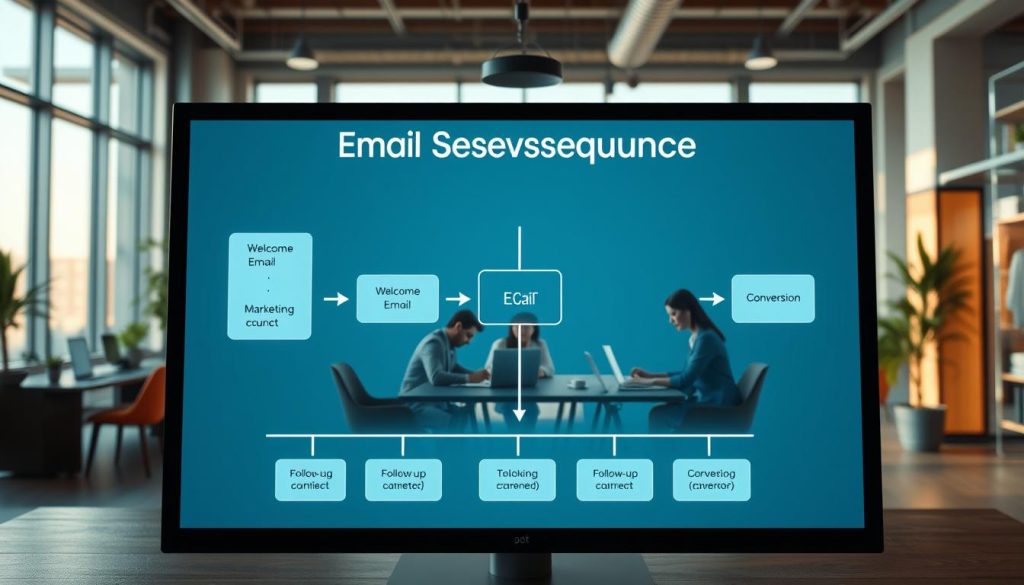
Understanding Automated Email Series
Email sequences are a series of emails sent out automatically. They’re not like one-time emails that everyone gets at once. Instead, they’re timed to match when customers are most likely to engage.
The drip campaign fundamentals mean sending content little by little. This keeps emails from feeling overwhelming. Emails are sent based on actions like signing up or downloading something.
Marketing automation sequences are different from emails sent by hand. They keep going without anyone needing to do anything. They also change based on what each customer does. And they can reach thousands of people at once.
Email marketing gives an average return of $42 for every dollar spent. It’s a very cost-effective way for businesses to reach people.
These sequences use rules to decide what to send next. If someone opens an email and clicks a link, they might get a follow-up. If they ignore it, they’ll get something different.
Why Email Sequences Matter for Business Growth
Email is one of the few things businesses can really control. With over 4.6 billion people worldwide using email in 2025, it’s a huge opportunity. Unlike social media, where algorithms can change suddenly, email goes straight to people’s inboxes.
Email sequences are important for more than just reaching people. They let businesses talk to lots of people at once, which is hard to do by hand. One marketer can help thousands of leads at the same time.
Email nurturing with artificial intelligence makes these sequences even better. They can learn what people like and send emails that fit their interests. This happens without needing someone to check it all the time.
But keeping an email list active is a lot of work. Lists can lose about 22.5% of their subscribers every year. Sequences help keep people interested and show them the value of staying in touch.
Marketing automation sequences also help track how well they’re doing. Every time someone opens or clicks an email, it helps the marketer know what’s working. This lets them make their emails even better over time.
Strategic Applications Across Customer Journeys
Email sequences are used in many ways, from welcoming new subscribers to helping them get the most out of their purchase. Each type has its own purpose and structure.
| Sequence Type | Primary Goal | Typical Length | Key Trigger |
|---|---|---|---|
| Welcome Series | Introduce brand values and set expectations | 3-5 emails over 7-14 days | Newsletter subscription |
| Educational Nurture | Build trust through valuable content | 5-10 emails over 4-8 weeks | Resource download |
| Sales Sequence | Address objections and guide purchase decisions | 4-7 emails over 10-21 days | Product interest indication |
| Cart Abandonment | Recover lost revenue from incomplete purchases | 2-4 emails over 24-72 hours | Items left in shopping cart |
| Onboarding Flow | Ensure product adoption and reduce churn | 6-12 emails over 30-60 days | Account creation or purchase |
Welcome sequences make a strong first impression. They introduce the brand, explain what to expect, and often offer something special.
Educational nurture campaigns build trust over time. They share valuable information, not just trying to sell. This makes the brand a trusted resource.
Sales sequences tackle common concerns. They might include testimonials, feature explanations, and special offers to make buying easier.
Cart abandonment sequences remind shoppers about items they left behind. They might offer discounts or free shipping to encourage a purchase.
Onboarding sequences help new customers get the most out of their purchase. They guide through setup, highlight key features, and share tips to improve satisfaction.
Re-engagement campaigns reach out to inactive subscribers. They offer new reasons to stay connected and sometimes ask if they can send more emails.
The drip campaign fundamentals are the same for all these types. They focus on clear messages, the right timing, and moving towards a goal. Each email should help the subscriber understand more without feeling pushed.
The Role of AI in Email Marketing
AI has changed how we do email marketing. Teams can now work faster without losing quality. This is thanks to AI systems that understand and create email flows.
One big plus is how fast things get done. Marketers can try out different messages in minutes. They don’t have to rewrite for every group.
How AI Systems Process Email Content
AI uses two key parts to make marketing copy. Natural language processing gets what we mean. Machine learning algorithms make it better over time.
AI breaks down text into parts it can understand. It knows about sentence structure and tone. This helps it make subject lines and calls-to-action that work.
Generative AI uses lots of data to learn what works. It’s not alone but helps by making drafts based on what we tell it.
AI gets better with feedback. When we tweak its work or see good results, it learns. This makes it better at matching our brand and audience.
Even those who aren’t tech-savvy can use AI. They just need to give basic info. Then, AI takes care of the rest.
Advantages That Transform Email Marketing Workflows
AI brings more than just saving time. It makes marketing teams more efficient.
Creating sequences is much quicker. This means teams can focus on strategy and making things better.
AI also makes personalizing messages easier. It can change content for different groups without needing to do it all by hand. This used to take a lot of work.
AI can also come up with new ideas. It finds benefits and answers objections in ways humans might not think of. This teamwork between humans and AI is powerful.
Keeping a consistent brand voice is easier too. AI helps keep the brand’s tone in all messages. This is hard to do by hand, but AI makes it simple.
| AI Capability | Traditional Method | AI-Enhanced Method | Time Reduction |
|---|---|---|---|
| Sequence Drafting | 2-3 days per sequence | 30-60 minutes per sequence | 90% faster |
| Segment Personalization | Manual rewrite for each segment | Automatic adaptation using machine learning for email campaigns | 85% faster |
| Subject Line Testing | 5-10 variations manually created | 50+ variations using generative AI email content | 80% faster |
| Brand Voice Consistency | Multiple review rounds needed | Natural language processing emails maintain voice automatically | 70% faster |
AI learns from lots of campaigns to make things better. It finds out what works for different groups and goals. This helps make future content even better.
AI helps solve the problem of starting from scratch. It gives initial drafts, so teams can focus on making things unique. This means more time for the important stuff.
With AI, teams can focus on the good stuff. They spend less time on writing and more on making messages emotional and strong. This leads to better results.
AI also brings up new ideas. It might suggest things we didn’t think of. These ideas can make a big difference in the final message.
How AI Can Create Email Sequences
AI makes creating email sequences easy. It uses machine learning for content, timing, and performance. First, you set the campaign goal. Then, you tell the AI what to do. It makes drafts, you check them, and then it sends them out.
This process used to take hours. Now, it’s fast and can be done on a large scale.
Modern systems can handle complex tasks better than old tools. They look at who you are and when you’re most likely to open an email. This makes your emails feel personal and timely.
Advanced Personalization Beyond Name Fields
Personalizing emails is more than just using names. Dynamic content generation uses your behavior and past actions. AI creates messages that really speak to you.
These systems look at many things about you. They use this info to make messages that fit your interests. For example, one person might get emails about saving money, while another gets emails about new features.

AI can change the way emails are written. It can make messages for people who are ready to buy or for those just looking. It can even change the tone of the email based on who you are.
This makes your emails feel like they were made just for you.
Some ways AI personalizes emails include:
- Recipient identifiers: Name, company, role, industry, and location
- Behavioral signals: Browsing history, clicking patterns, and content engagement
- Transaction data: Product preferences, purchase history, and cart abandonment
- Engagement metrics: Email open rates, response patterns, and device usage
- Psychographic factors: Communication preferences, value alignment, and decision-making style
Smart Automation for Optimal Timing
AI figures out the best time to send emails. Behavioral email triggers send emails when you’re most likely to see them. This includes when you open an email or click on a link.
AI looks at when you usually open emails. If you always check your emails in the morning, it will send them then. This makes more people open your emails.
AI also changes the email based on how you react. If you click on a link, you might get more emails about that topic. If you ignore emails, you might get different ones.
AI also works with other ways to reach you. It can send emails and texts at the same time. This makes your experience feel more connected.
AI handles complex tasks easily:
- Detecting engagement signals across multiple channels
- Adjusting sequence pacing based on recipient responsiveness
- Pausing sequences when recipients take desired actions
- Re-activating dormant contacts with tailored re-engagement campaigns
- Coordinating timing to avoid message fatigue
Continuous Learning Through Data Analysis
AI can learn a lot from your email data. It finds out what works best for different people. This happens all the time.
AI looks at what parts of your emails get your attention. It finds out where you lose interest and what you like to read. It even knows if you prefer to read emails on your phone or computer.
This helps make your emails better over time. What works well gets even better. AI tries different things and sees what works best.
AI tracks many things, including:
- Engagement indicators: Open rates, click-through rates, and time spent reading
- Conversion metrics: Response rates, meeting bookings, and purchase completions
- Behavioral patterns: Sequence progression rates and drop-off stages
- Content effectiveness: Subject line performance and call-to-action success
- Timing optimization: Best send times and ideal sequence intervals
AI uses what you do to make your next email better. This makes the system smarter and more effective over time.
| Personalization Type | Traditional Approach | AI-Powered Method | Impact on Engagement |
|---|---|---|---|
| Basic Identification | Name and company insertion using merge tags | Contextual references based on recipient role and industry challenges | 15-25% improvement in open rates |
| Content Adaptation | One message for all recipients in segment | Dynamic content generation tailored to psychographic profiles | 35-50% increase in click-through rates |
| Timing Optimization | Fixed schedule for entire list | Individual send time prediction based on engagement history | 20-30% better response rates |
| Behavioral Response | Manual list segmentation after action | Automated follow-up emails triggered by specific behaviors | 40-60% faster progression through funnel |
Using AI for email campaigns really works. Teams save a lot of time and get better results. AI takes care of the details, so humans can focus on the big picture.
Popular AI Tools for Email Sequence Generation
Marketers today have many choices for email sequence tools. The field has moved beyond simple templates to advanced AI platforms. These platforms understand context and audience behavior. It’s important to pick the right tool for your workflow.
Each tool has its strengths. Some are great at creating content, while others focus on automation and integration. The goal is to match the tool’s strengths with your marketing goals.
Platform Categories and Strengths
ChatGPT for email marketing has changed how marketers run campaigns. These tools are good at keeping a story going in a series of emails. They understand the context of previous emails, making customer journeys smooth.
Claude and similar tools keep your brand voice consistent. They are perfect for companies with strict tone guidelines. This is important for financial services, healthcare, and B2B companies.
CRM-integrated systems are another strong category. Tools like HubSpot and Salesforce Marketing Cloud have built-in AI. They are great for campaigns that use behavioral triggers and sales data.
Having everything in one system makes managing campaigns easier. Your email sequences can adjust based on website visits and form submissions. This makes complex campaigns simpler to manage.
Creator-focused platforms like ConvertKit have added AI features. These tools are good for solopreneurs and small teams. They help with routine content, letting creators focus on strategy.
Ecommerce specialists like Klaviyo are trained on shopping behavior. They are great for abandoned cart recovery and upselling. Their predictive features help with repeat purchases.
Evaluation Framework and Investment
When comparing email sequence tools, look beyond price. Content quality varies a lot. Test each tool with your actual use cases before committing.
Personalization depth is key to campaign success. Basic systems use names and company names. Advanced platforms analyze purchase history and browsing behavior. See how well each tool can personalize at scale.
| Capability | Entry-Level Tools | Mid-Market Solutions | Enterprise Platforms |
|---|---|---|---|
| Monthly Investment | $29 – $99 | $199 – $999 | $2,000 – $10,000+ |
| AI Generation Quality | Template-based with variables | Context-aware with learning | Advanced reasoning with brand training |
| Integration Options | Basic API connections | Native CRM sync | Full marketing stack integration |
| Automation Sophistication | Simple drip sequences | Behavioral triggers and branching | Predictive send times and AI optimization |
| Best For | Solopreneurs and startups | Growing businesses with active campaigns | Large teams with complex workflows |
Pricing models vary across AI email platforms. Per-user subscriptions work for small teams but get expensive. Usage-based pricing offers flexibility but requires budget monitoring.
Some marketing automation software includes AI in their plans. Others charge extra for advanced features. Consider the total cost, including integration and training expenses.
Implementation Realities and User Insights
Marketers report learning curves from days to months. The AI’s power requires understanding how to use it well. This takes time and effort.
It takes weeks to see the quality of AI outputs match expectations. Initial emails often need a lot of editing. As teams get better at providing context, quality improves a lot. Being patient during the learning phase is key.
There’s a balance between automation and control. Full automation saves time but can go off-brand. Manual review defeats efficiency gains. Successful teams have review workflows for important emails.
No tool is best for every use case. The right choice depends on your infrastructure, team skills, campaign complexity, and budget. Companies with mature CRM systems often benefit from integrated solutions. Startups with limited budgets prefer standalone tools.
User feedback shows that successful implementation requires matching the tool to your needs. The most expensive tool won’t work if it doesn’t fit your workflow. Mid-tier solutions often outperform premium options when they integrate well with your systems and processes.
Best Practices for AI-Generated Email Sequences
Turning AI-generated email sequences into top-notch campaigns requires focus on key elements. These elements boost subscriber engagement. AI tools are great for creating content and automating tasks. But, it’s the strategic tweaks that make campaigns stand out.
The question of can AI generate email sequences goes beyond just content. Success comes from blending AI with proven marketing strategies. These strategies influence how recipients react to your emails. Adding valuable resources keeps subscribers interested throughout the sequence.
Success is measured by watching key metrics closely. Aim for open rates above 50% and bounce rates under 5%. These numbers show if your optimization efforts are working.

Creating Irresistible Opening Lines
Email subject line optimization is key to campaign success. Your subject line decides if people open your email or delete it. AI is good at making different subject lines to test various approaches.
AI tools use many techniques to create subject lines. These include curiosity gaps, direct benefits, personal touches, urgency, and questions. These techniques grab attention and encourage people to open the email.
Effective AI-generated subject lines follow certain guidelines:
- Length optimization: Keep subject lines between 40-50 characters for mobile device compatibility
- Spam avoidance: Avoid words like “free,” “guaranteed,” or too much punctuation that hurts deliverability
- Deep personalization: Use company names, recent behaviors, or referenced pain points instead of just first names
- Systematic testing: A/B test variations to see what works best for different audience segments
- Authenticity maintenance: Make sure subject lines accurately reflect the email content and keep your brand’s integrity
Good prompts guide AI systems like a creative brief. Clear inputs lead to cleaner drafts and fewer rewrites. A few focused lines usually outperform long, rambling instructions when directing AI to generate subject line options.
The best subject lines create an irresistible promise that the email content delivers on completely.
Preview text optimization works with subject lines to boost open rates. This often-overlooked element appears next to or below the subject line in most email clients. AI can generate preview text that complements your subject line, providing additional context without repeating the same information.
While AI generates creative options quickly, human judgment remains essential for final selection. Review AI suggestions to ensure they align with your brand voice and authentically represent the message recipients will find inside.
Strategic Scheduling and Contact Frequency
Send time optimization is vital for email sequence performance. Research shows weekdays are best for most industries. Thursday, Tuesday, and Wednesday are the top days for engagement across various sectors.
Different industries have unique optimal timing patterns based on audience behavior:
| Industry | Best Days | Optimal Time | Engagement Window |
|---|---|---|---|
| E-commerce | Tuesday/Thursday | 10:00 a.m. | Morning browsing periods |
| Software/SaaS | Tuesday/Thursday | 2:00-3:00 p.m. | Post-lunch work sessions |
| Marketing Services | Wednesday | 4:00 p.m. | Mid-week planning time |
| B2B Services | Tuesday/Wednesday | 10:00 a.m.-12:00 p.m. | Business hours peak |
Email sequence cadence needs a balance between persistence and respect for recipient attention. The Fibonacci sequence approach offers an effective spacing strategy. This method sends emails on days 0, 1, 1, 2, 3, 5, 8, and 13, creating natural intervals that feel less intrusive.
Behavioral timing takes personalization further by adjusting send schedules based on individual engagement patterns. AI systems can analyze when specific recipients typically open emails and automatically optimize delivery times for each person.
Sequence length varies based on campaign objectives. Cold email sequences work best with 4-5 emails, while nurturing campaigns may extend to 3-8 messages depending on complexity. Shorter sequences suit time-sensitive promotions, while longer sequences better support complex onboarding or educational content.
Consider these frequency guidelines to maintain subscriber engagement:
- Initial contact: Send first follow-up within 24-48 hours while interest remains high
- Mid-sequence: Space emails 2-4 days apart to maintain awareness without overwhelming
- Final messages: Increase intervals to 5-7 days, allowing more consideration time
- Re-engagement: Wait 2-3 weeks before attempting to revive cold prospects
Warning against over-mailing is key for list health. Sending too frequently leads to unsubscribes and spam complaints that damage sender reputation. Yet, insufficient touchpoints risk losing awareness and allowing competitors to capture attention.
Optimal timing and frequency require continuous testing. AI tools can analyze your specific audience response patterns and recommend adjustments based on actual engagement data. Monitor metrics consistently and refine your approach based on what your particular subscribers demonstrate through their behavior.
The combination of compelling subject lines and strategic timing creates powerful synergy. When AI-generated content reaches recipients at the right moment with irresistible opening lines, email sequences achieve their maximum for driving conversions and building lasting customer relationships.
Limitations and Challenges of AI in Email Marketing
AI in email marketing is promising but comes with challenges. It brings efficiency and scale but also problems that can hurt campaign success. Knowing these challenges helps teams use AI wisely, blending it with human insight.
Marketers who jump into AI without understanding its limits often face issues after launching campaigns. About 50% of people can spot AI-generated content, and 52% don’t engage with it as much. This shows that automation without care creates less effective messages.
When Automation Creates Quality Problems
AI’s limitations are clear when quality control is lacking. Generic emails are common, lacking the unique voice that connects with people. These emails could belong to any brand, making them forgettable.
Too much automation makes emails feel cold and impersonal. People sense the mechanical feel, even if they can’t explain why. This makes messages less engaging.
AI can also spread false information, making it harder to detect. This requires humans to check all facts and details before sending. A single mistake can harm a brand’s reputation for years.
The most successful email programs use AI as a starting point, not a finish line. Human refinement transforms competent drafts into compelling communications.
Tone issues often arise in AI emails. Content can swing from too formal to too casual, confusing recipients. This can harm how people see your brand.
To fix these issues, teams need to establish quality control steps:
- Brand voice validation: Check if AI output fits your brand’s tone and personality
- Fact-checking protocols: Verify all data and claims before sending
- Context verification: Make sure personalization makes sense for each group
- Human readability testing: Have team members read emails aloud to catch awkward phrasing
Teams that ignore human judgment face problems like low engagement and customer complaints. Regular checks are better than fixing issues after they happen.
Navigating Ethical Territory
Email marketing ethics is key as AI grows. Studies show 94% of consumers want companies to say when content is AI-generated. This raises a big question: should brands reveal AI use?
Disclosing AI use can build trust but might make content seem less valuable. Finding the right balance between efficiency and authenticity is a big challenge. AI misuse can harm customer relationships, which email marketing aims to strengthen.
Data privacy is another big issue with AI email marketing. Personalization needs customer data, which must be handled carefully. AI must respect privacy rights and follow strict rules.
Here are some ethical guidelines for using AI responsibly:
- Transparency standards: Have clear policies on when and how to reveal AI content
- Privacy protections: Use data handling practices that go beyond the minimum
- Human oversight requirements: Always have humans review emails on sensitive topics
- Bias monitoring: Regularly check AI output for biases and correct them
AI can carry biases from its training data, creating messages that exclude some groups. Regular audits help catch these issues. Diverse review teams can spot problems that others might miss.
Being ethical with AI is not just about following rules; it’s about gaining a competitive edge. Brands that use AI responsibly build stronger trust and reputation. Consumers value authenticity over efficiency.
Email marketing ethics means keeping human connection at the core. AI is a helpful tool, but the responsibility for ethical communication lies with humans. Clear guidelines protect both customers and brands in an automated world.
Case Studies of Successful AI-Generated Emails
Companies across various industries have seen great results from using AI-generated email sequences. These real-world examples show how businesses use artificial intelligence to send personalized emails at scale. They also see big improvements in engagement and revenue.
Here are some case studies that show different ways businesses use AI for email marketing. Each story talks about the challenges they faced, how they used AI, and the results they got. These results show how valuable AI can be for businesses.
Real-World Brand Implementations
A big e-commerce site changed how they handle cart abandonment with AI emails. They sent a series of three emails to customers who left items in their cart. Each email was personalized based on what they looked at and how much they had in their cart.
The first email went out within an hour to remind them about their items. The second email, 24 hours later, showed social proof and customer reviews. The last email offered a special deal to encourage them to buy.
This strategy brought back 15% of abandoned carts, adding millions to their yearly sales. They found that emails with special offers recovered 50% more carts than emails without them. This shows how important it is to use special offers wisely.
A growing SaaS company changed their onboarding process with AI emails. New users got personalized tutorials based on their role and what they did first. The AI figured out which tutorials would help them use the product best.
The emails changed as users interacted with different parts of the product. Users who were really into the product got advanced tips. Users who were hesitant got simpler help and encouragement. This made it 34% less likely for users to leave within the first 30 days.
A B2B professional services firm used an AI email builder to reach more people. The AI made personalized emails for different industries and roles. It included research and case studies specific to each company.
Each email had four to six parts over three weeks. The AI adjusted the emails based on how people interacted with them. This smart approach got three times more responses than their old manual emails.
They found that emails that taught something new worked better than just trying to sell. The AI helped find what problems people had, leading to real conversations that sales teams could follow up on.
Measurable Performance Outcomes
The results from these AI email campaigns show how well they work. Companies that use AI to segment their emails can make up to 760% more money than those that don’t. This shows how important it is to send emails that are really relevant.
AI emails that are well-optimized get open rates over 50%, way above average. These emails also have bounce rates under 5%, showing they are well-made and the lists are good.
| Campaign Type | Open Rate | Click-Through Rate | Conversion Rate |
|---|---|---|---|
| Cart Abandonment | 52% | 18% | 15% recovery |
| Welcome Sequence | 58% | 24% | 34% activation |
| Re-engagement | 25% | 8% | 12% reactivation |
| Cold Outreach | 38% | 12% | 6% response |
Re-engagement campaigns show AI can bring back subscribers who might have left. Emails that show empathy can get 25% open rates from people who hadn’t opened emails in a while. This brings back valuable contacts.
The ROI from email marketing gets even better when you use AI. Marketing teams can make emails faster without losing quality. This lets them focus on creative and strategic work that needs a human touch.
One big company saved 120 hours a month by using AI for emails. This extra time let them make better customer journeys and learn more about their audience. This made their campaigns even better.
Companies that use AI well save time without losing quality. AI handles the boring tasks, and humans focus on the creative and strategic parts. This teamwork leads to better results than either side could do alone.
These examples show that the best results come from using AI and human judgment together. Brands that do well use AI for data, variation, and timing. But they keep human control over the message, voice, and ethics.
Future Trends in AI Email Marketing
AI and changing consumer habits are changing email marketing. The next decade will see email marketing evolve beyond simple automation. It will involve systems that learn, adapt, and improve on their own.
Email sequences are becoming more dynamic. They now respond to audience behavior and market changes. This shift marks a big change in marketing, moving towards adaptive strategies.
What Technology Will Bring
The next decade will see big leaps in personalization technology. Machine learning will analyze real-time emotions, making emails more personal. Emails will now respond to how customers feel, not just what they do.
Predictive email personalization will get even better. Systems will guess what customers need before they ask. This makes email a proactive tool, not just a reactive one.
Dynamic sequences will replace old workflows. Campaigns will change based on how each person interacts with them. This means emails can grow, shrink, or change direction as needed.
Natural language generation will make AI content seem human. This raises questions about authenticity and transparency. It will also let small teams do big things, making advanced email marketing more accessible.
AI will make multi-channel integration seamless. Email will be part of a bigger ecosystem, adapting to interactions across different platforms. This will create more holistic experiences for customers.
Rules for using AI in marketing will change. New laws will cover data privacy, algorithm transparency, and disclosures. Keeping up with these changes will be key to success.
How Consumer Attitudes Are Changing
More people can spot AI-generated content. This number will grow as people get used to automated messages. Marketers need to adapt to this awareness.
People want real personalization, not just superficial customization. They want experiences that truly understand them, not just use their name or past purchases.
Privacy is a big issue in email marketing. People want personalized experiences but also protect their data. Brands that balance these needs will build stronger relationships.
Younger people have different email preferences. They value authenticity, brevity, and mobile optimization more than older generations. Marketing strategies need to consider these differences.
The best email marketing will use AI but keep a human touch. Technology helps personalize, but human insight and empathy are key. Brands that use AI well will stand out.
This changing landscape offers both challenges and opportunities. Marketers who focus on customers and use AI wisely will thrive. The future belongs to those who keep human relationships at the heart of their marketing.
Conclusion: The Future of AI in Email Marketing
Yes, AI can generate email sequences, and it’s changing how companies reach out to their customers. AI email marketing automation makes content, personalizes messages, and optimizes data quickly. It’s great at doing the work, while humans guide the strategy and add a creative touch.
The Human-AI Partnership in Modern Marketing
Success comes from combining human insight with AI’s speed. Humans provide the big ideas, and AI does the rest. Teams that succeed see AI as a partner, helping with content and analysis while keeping messages real.
Content that answers questions well does best today. Marketers who know how to work with AI will thrive. They’ll make content that resonates and delivers results.
Starting Your AI Email Journey
Getting started with marketing automation is easier than ever. Start with simple sequences like welcome emails or reminders about abandoned carts. Try different tools and see what works best through A/B testing.
Find one email challenge you face now. See how AI can help solve it. Practical experience is key. Combining human strategy with AI’s power boosts email performance.