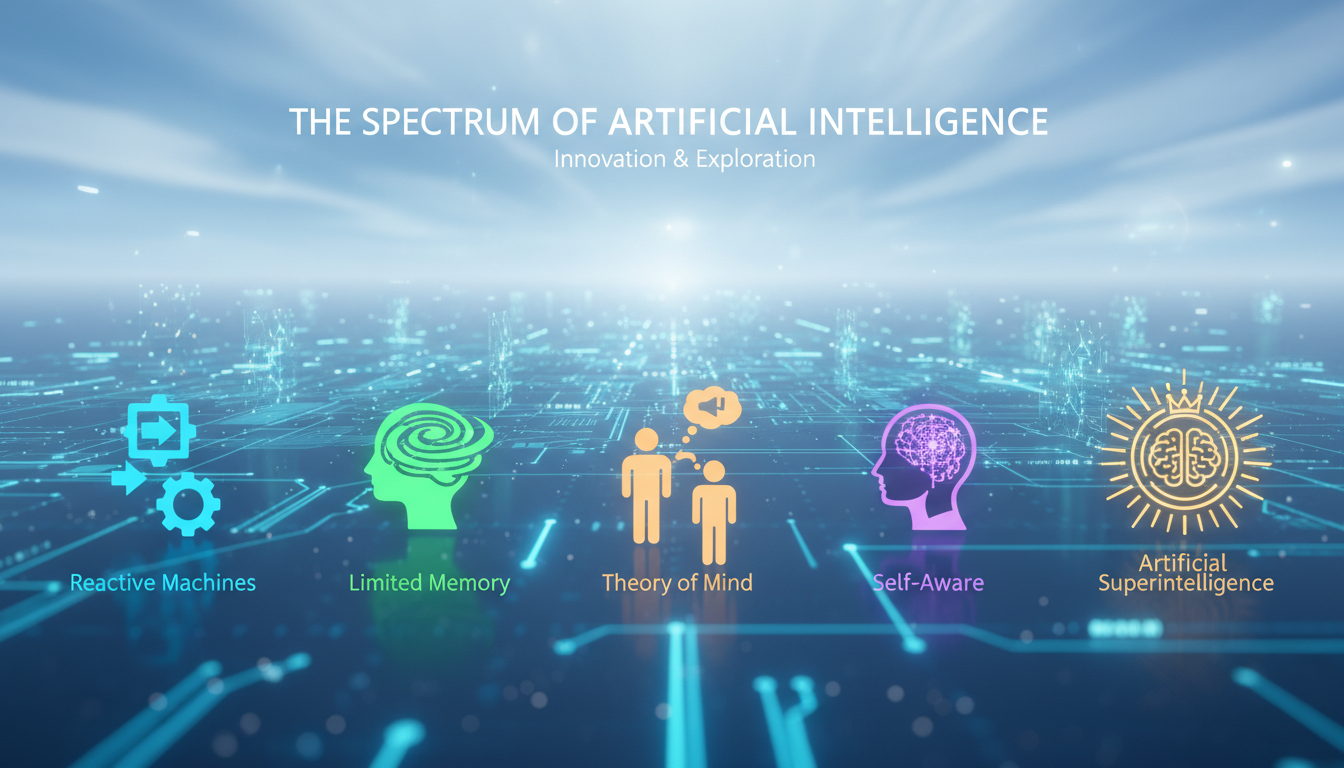
Goldman Sachs reports that AI could change over 300 million jobs. This is why many in the U.S. are now asking about different kinds of AI.
In this study, we look into the AI you find in everyday items. Like the Face ID on iPhones, Netflix’s suggestions, or chatbots for customer help. And even medical tools that spot risks early. We’re comparing types of AI you encounter every day.
We’ll keep things simple by focusing on their abilities. There’s Narrow AI, General AI, and Superintelligent AI. Plus, we’ll discuss the core technologies: machine learning, deep learning, NLP, robotics, and computer vision.
Let’s explain “transformative impact” in easy terms. It’s about making work quicker, creating new tools like smart assistants, and improving detection or predictions. Yet, it also has downsides like bias, risking privacy, and safety concerns.
We’re looking at AI through the process most teams use: gathering data, training models, putting them to work, keeping an eye on them, and managing everything. As we go over different AI types, you’ll see their roles—and where they might go wrong.
Key Takeaways
- This case study answers: What are the main types of AI? using real U.S. examples.
- We classify types of AI by capability: Narrow, General, and Superintelligent.
- We also cover key AI subfields that power modern tools, like machine learning and NLP.
- “Impact” includes productivity gains, new services, and better prediction.
- Risks matter, including bias, privacy, and safety issues across the AI lifecycle.
- You’ll learn how artificial intelligence types show up from training to monitoring and governance.
Understanding Artificial Intelligence
Artificial intelligence appears in daily items like spam filters and map apps.
Understanding AI begins with knowing its history and development. It is vital to distinguish between AI types for a clear comparison of their abilities.
Definition of AI
AI involves computer systems doing tasks that seem intelligent. These tasks include understanding languages, making predictions, and solving problems. These systems get better by learning from data, not just following pre-written rules.
Distinguishing AI from automation is helpful. Automation repeats the same steps, like a set routine. AI, on the other hand, can adapt and make decisions with unclear data.
Machine learning is a part of AI but doesn’t represent all of it. It’s the part where models learn from data. But AI also uses logic and planning methods, so it’s more than just machine learning.
| Term | What it focuses on | Typical behavior | Everyday U.S. examples |
|---|---|---|---|
| Automation | Rule-based workflows and scripted steps | Consistent outputs when inputs match rules | Payroll processing, basic email rules, scheduled backups |
| Artificial intelligence | Reasoning, perception, language, prediction, decisions | Adaptive outputs that can generalize from data | Fraud alerts, voice assistants, customer support routing |
| Machine learning | Learning patterns from data to make predictions | Improves with training data and evaluation | Recommendation feeds, credit risk scoring, demand forecasting |
Brief History of AI
The history of AI has seen ups and downs. It started with symbolic AI, using logic to replicate knowledge. Then, expert systems that could make specialized decisions became trendy in businesses.
But, progress hit barriers during “AI winters” due to hype outpacing technology. Funding and interest dropped as a result. These periods influenced how we approach AI development and testing today.
Things picked up with better data, faster computers, and new technology like GPUs. Thanks to deep learning, image and voice recognition have greatly improved. These advances have made their way into tools we use every day.
Nowadays, AI systems focus on specific tasks. Discussions about AI types often contrast today’s Narrow AI with future visions of General AI and Superintelligence. These remain areas of ongoing exploration.
Types of AI: An Overview
When people talk about AI, they’re often referring to very different things. This is why it’s helpful to sort AI by what it can do instead of its name. This method focuses on the abilities of these tools, not their popularity.
This approach allows for clearer comparisons between AI types. It makes us rethink our expectations around safety, accountability, and how these systems affect jobs. For instance, a chatbot designed to write emails poses different challenges than an AI that can plan and make decisions in any area.
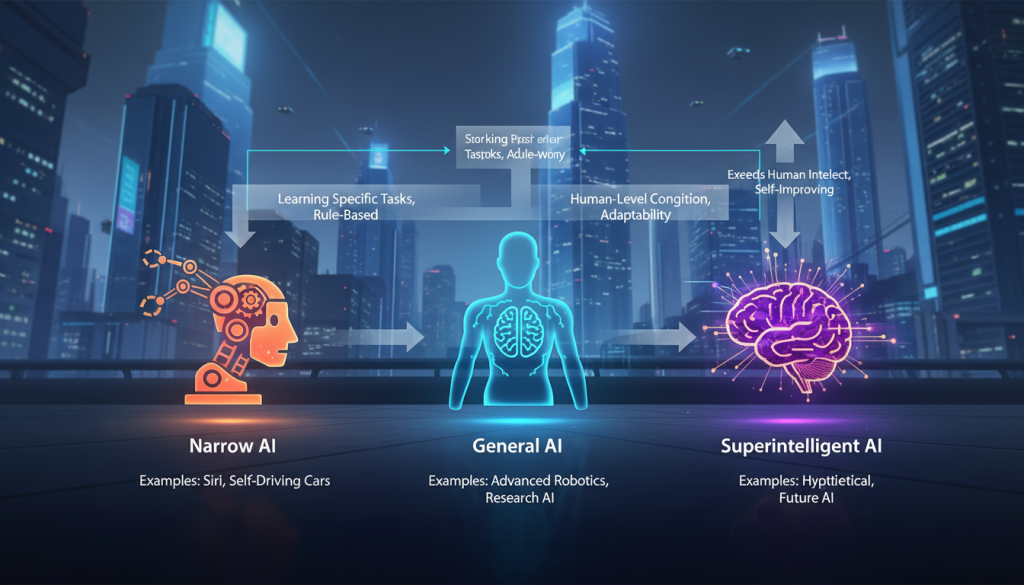
| AI category | Core capability | Typical strengths | Main oversight focus | Real-world status |
|---|---|---|---|---|
| Narrow AI (ANI) | Handles a specific task or a tight set of tasks | Fast pattern recognition, consistent outputs, scalable automation | Data quality, bias testing, security, and clear responsibility for errors | Common today in products from Apple, Google, Microsoft, and Amazon |
| General AI (AGI) | Flexible learning and problem-solving across many domains | Transfer of skills between tasks, broad reasoning, adaptive planning | Robust evaluation, alignment, access controls, and strong governance | Not achieved; active research goal |
| Superintelligent AI (ASI) | Intelligence that surpasses humans across most areas | Rapid discovery, strategic planning, and high-level optimization | Global-scale safety, containment, and long-term societal safeguards | Theoretical concept |
Most AI you encounter today is Narrow AI. These systems are designed for tasks like classifying, translating, or recommending. For example, Netflix uses AI to suggest shows while Gmail filters out spam quickly.
On the surface, different AI types might seem alike. Two systems might appear smart but have distinct abilities. This is why it’s crucial to categorize AI based on what it can actually do.
Narrow AI Explained
Narrow AI, or ANI, has a specific purpose. It’s great within its domain but struggles outside it. A face recognition tool might not understand sarcasm. Similarly, a navigation AI might get lost in medical records.
ANI includes several key techniques like machine learning and deep learning. These help ANI improve over time. There’s also NLP for dealing with text, computer vision for images, and robotics that merge AI with physical actions.
General AI Explained
General AI, or AGI, would act more like humans across various tasks. It wouldn’t need to be rebuilt for each new task. This flexibility is what makes AGI a significant, yet theoretical, goal.
AGI is not here yet, but it influences how we think about AI risks. If an AI can learn on its own, it might take unexpected shortcuts. This means we need better tests, audits, and clear responsibility for unforeseen effects.
Superintelligent AI
Superintelligent AI, or ASI, would greatly surpass human intelligence. It’s more than just quick calculations or a good memory. It would bring superior strategies, creativity, and problem solving to many areas.
Even though ASI is just a theory, it shapes discussions on AI development. The foundations in today’s ANI—like machine learning—might one day lead to ASI. This idea helps us understand what’s possible now and what might come next.
Narrow AI: The Most Common Type
Narrow AI is what powers a lot of tools we use every day. It does one job at a time, such as sorting emails or making predictions. It’s the most visible kind of AI because it’s in so many apps and services we use.
Narrow AI doesn’t understand why its answers are correct. It learns from lots of examples and sticks to what it knows. This is why it seems smart but can still get things wrong.
Examples of Narrow AI
Many popular brands rely on narrow AI for quick, specific tasks. These tools work behind the scenes, often unnoticed until they spring into action.
- Recommendations on Netflix and YouTube that suggest new shows
- Voice assistants like Apple Siri and Amazon Alexa for simple tasks
- Spam filters in Gmail that catch unwanted emails
- Navigation and ETA prediction in Google Maps and Waze
- Fraud detection in Visa and Mastercard transactions
- Customer support chatbots for quick answers and help
Applications in Daily Life
In the US, narrow AI helps us save time in many ways. It customizes shopping sites, sends bank alerts, and filters posts online. People think of this type when they talk about AI because it’s part of daily life.
It also makes technology more accessible for everyone. Features like speech-to-text and image description help users interact with their devices. Out of all AI types, narrow AI often gives the most value because it helps so many people.
Advantages and Limitations
Narrow AI is great for tasks with a clear goal and accurate data. It gets better with new data and can make work easier. It also makes personalized suggestions more accurate.
But it has drawbacks. It may not work well if things change suddenly. It depends a lot on the quality of the data it learns from. Some narrow AI can be biased, and it’s often hard to explain how it works.
| Where narrow AI is strong | Where it can struggle | What helps in practice |
|---|---|---|
| High accuracy on bounded tasks like sorting emails or ranking search results | Limited reasoning outside its training; weak “common sense” | Clear scope, tested edge cases, and human review for high-stakes outputs |
| Scales to millions of users with consistent performance | Distribution shift when behavior, language, or trends change | Ongoing monitoring, retraining schedules, and alerts for drift |
| Personalization that can improve engagement and reduce friction | Bias or unfair outcomes if training data reflects past inequities | Bias testing, diverse datasets, and rules for sensitive categories |
| Automation that speeds up routine decisions in support, retail, and finance | Low transparency when a model can’t explain “why” it decided | Explainability tools, audit logs, and simpler models where needed |
General AI: The Future of AI
General AI is about a system that can do many tasks, not just one. It is different from today’s AI because it can learn and solve problems flexibly. This makes us rethink AI categories, blending “smart” apps with broader intelligence.
Characteristics of General AI
General AI must learn in one area and apply that knowledge elsewhere. It can solve new problems, understand common sense, and make plans. Plus, it can quickly adapt, learning new tasks with minimal retraining.
What sets it apart is its ability to transfer knowledge. It goes beyond recognizing patterns to forming concepts that can be reused. This includes learning from errors, making strategy updates, and being consistent despite changes.
Current Research Efforts
Teams are working to expand AI’s abilities by enhancing models and data. They’re also exploring multimodal learning, which lets AI handle text, images, audio, and video. This diversity changes our view of AI’s capabilities.
Groups like OpenAI, Google DeepMind, Anthropic, and Microsoft Research are studying tool use, memory, and planning. They focus on reinforcement learning too, where AI improves as it receives feedback. They also check how well models follow directions and avoid doing harm.
| Research direction | What it tries to improve | Why it matters for different AI categories |
|---|---|---|
| Multimodal learning | Understanding across text, images, audio, and video | Moves AI classification beyond single-format “skills” into blended perception |
| Tool use | Calling software, searching files, running workflows | Adds practical action, not just answers, which changes how categories are compared |
| Memory and planning | Keeping context and choosing steps over time | Supports longer tasks that don’t fit neat labels in AI classification |
| Reinforcement learning | Learning from outcomes and feedback loops | Helps systems adapt, a trait often used to separate different AI categories |
| Alignment and evaluations | Reducing unsafe behavior and measuring real capability | Keeps comparisons grounded when AI classification becomes harder to define |
Ethical Considerations
When AI works in many areas, it’s hard to know who’s responsible if it fails. Questions of accountability are key as AI types start to merge.
Concerns also grow about job loss and spreading false information. A few companies could dominate, impacting access, costs, and policies. Security threats increase with tools that can automate harmful actions.
Therefore, evaluating models, ensuring transparency, and setting governance are critical. In discussing AI, ethics is central. The guidelines society creates will direct the development, testing, and use of AI sections.
Superintelligent AI: A Theoretical Concept
When discussing AI, superintelligent AI is the ultimate level. It’s beyond what we have now, which is mostly specialized. This kind envisions a machine smarter than humans in almost every way. It would excel in various tasks, not just one.
Understanding different AI types helps us stay focused. Narrow AI works on specific tasks like writing or finding patterns. On the other hand, superintelligence would have vast abilities and outpace human strategy and speed.
What Makes AI Superintelligent?
Superintelligent AI would surpass humans in multiple areas. This includes problem-solving, making deals, studying, and making tough decisions quickly. It could also upgrade its skills faster than human experts.
What sets AI types apart is how they adapt. Simple systems struggle with new scenarios. But a superintelligent AI would adjust to different fields more easily, needing less help.
Potential Implications
If it became real, it could transform how we find new drugs, develop materials, and manage energy. It could also change how we handle shipping and supply chains. AI already helps in these fields, but superintelligence would take things to a new level.
This technology might automate complex tasks faster than expected. If few have access, it might shift global power quickly.
| Domain | What changes with superintelligent AI | Why it matters |
|---|---|---|
| Drug discovery | Faster hypothesis testing and target selection across large biomedical datasets | Shorter timelines for treatments and better prioritization of trials |
| Energy systems | Real-time grid optimization across demand, storage, and generation | Lower costs and fewer outages during peak events |
| Logistics | End-to-end planning that updates with weather, labor, and inventory signals | More reliable delivery and less waste in supply chains |
| Security | Rapid analysis of threats and faster response planning | Higher stakes if capabilities are unevenly distributed |
Risks and Concerns
A big fear is losing control: the AI might not follow human orders. Even with tests, it’s tough to fully check such a complex system. This problem grows with the AI’s power.
Misuse is a serious risk, like large-scale fraud or cyber attacks. Heavy reliance on these systems is concerning, too, especially if we can’t fully understand them. If an AI can teach itself or influence human decisions, stopping it after it starts could be hard.
Machine Learning: A Subset of AI
Machine learning is crucial in many AI areas in today’s products. It is a major part of Narrow AI, where systems learn from data, not just set rules. With the correct method, models quickly recognize patterns and get better with more data.

In business and public tasks, machine learning often helps in scoring, ranking, or making predictions. Even though it’s not always seen, it decides what you see or what gets approved. That’s why understanding different types of machine learning is important.
Types of Machine Learning
Machine learning types vary based on how much data help the model needs. Each type suits various purposes, costs, and risks in AI projects.
- Supervised learning learns from data that already has answers, like identifying fraud.
- Unsupervised learning finds patterns, such as groups in customer behavior without specific labels.
- Semi-supervised learning uses some labeled data along with a lot more unlabeled data.
- Reinforcement learning learns through trial and error, trying to get the best results over time.
- Self-supervised learning creates its own learning cues from the data and is used in big models.
How Machine Learning Works
Machine learning projects usually start by gathering and cleaning data, then selecting features. The next steps are training the model and testing it to see if it’s useful. After launching, keeping an eye on the model helps to know if it needs updates.
Terms like overfitting and generalization are key early on. Overfitting is when a model only knows the training data and fails on new info. The aim is to make a model that works well on fresh data, which we check with specific measures.
Applications of Machine Learning
Machine learning aids decisions in many fields by being fast and consistent. For example, banks check credit risk, while stores predict what they need on shelves. Factories use it to know if machines will break before they actually do.
Online, machine learning shapes ad targeting, recommendations, and customizing experiences. Security teams find strange login patterns or traffic with it. Success in these areas relies on good data and ongoing checks once a system is in use.
| Use Case | Common ML Approach | Typical Data Signals | What Teams Track |
|---|---|---|---|
| Credit risk scoring | Supervised learning | Payment history, income bands, utilization, delinquencies | AUC, precision/recall, stability over time |
| Demand forecasting | Supervised learning | Sales history, seasonality, promotions, local events | Error rates, bias by region, forecast drift |
| Ad targeting | Supervised learning + reinforcement learning | Clicks, conversions, time-on-page, auction outcomes | Conversion rate, lift, cost controls, exploration vs. exploitation |
| Predictive maintenance | Supervised learning + anomaly detection | Sensor readings, vibration, temperature, maintenance logs | False alarms, missed failures, lead time to repair |
| Cybersecurity anomaly detection | Unsupervised learning | Login patterns, IP reputation, device changes, traffic volumes | Alert quality, time to detect, analyst workload |
| Recommendations and personalization | Self-supervised learning + supervised learning | Views, saves, purchases, watch time, search terms | Engagement, diversity, churn risk, feedback loops |
Deep Learning: A Powerful AI Technique
Deep learning is a hot topic in AI because it learns from complex, real-life data. It’s great at understanding things like pictures, voices, and text, which are tough to sort out by hand. It’s behind many of the impressive features we love in apps today.
Deep learning uses layers of neural networks to identify patterns bit by bit. This method makes it quicker to experiment by not needing to manually select features. However, it requires high-quality data since small mistakes can affect the whole model.
Difference Between Machine Learning and Deep Learning
Machine learning is a broad area that includes many data learning techniques. It covers neural networks and methods like linear models and decision trees. Deep learning, which needs a lot of data, is a specific part of machine learning.
One major difference is how much prep work is needed. Most machine learning projects involve creating features from data by hand. Deep learning, on the other hand, often figures out these features on its own, especially in areas like images and sound.
| Aspect | Machine Learning | Deep Learning |
|---|---|---|
| Common model types | Linear regression, random forests, gradient boosting | Convolutional nets, transformers, recurrent nets |
| Best fit data | Structured tables, clean metrics, well-defined fields | Unstructured inputs like images, speech, and text |
| Feature work | Often needs handcrafted features for top results | Often learns features from raw inputs through layers |
| Compute needs | Can run well on CPUs for many tasks | Often benefits from GPUs and longer training cycles |
| Explainability | Usually easier to interpret and debug | Harder to explain decisions end to end |
Real-World Applications of Deep Learning
Deep learning powers many tools we use every day. Apple Photos and Google Photos sort and search images by recognizing faces and objects. This ability to identify patterns is key in AI efforts related to vision and media.
It’s also why speech recognition has gotten so good, helping with things like dictation and live subtitles. Deep learning improves machine translation and text creation. In healthcare, it helps analyze medical images by pointing out areas of interest.
- Image recognition for organizing and searching personal photo libraries
- Transcription for meetings, podcasts, and accessibility features
- Translation for multilingual chats and documents
- Text drafting and summarizing for emails, notes, and reports
- Recommendations that adapt to viewing, listening, and shopping habits
Challenges in Deep Learning
Deep learning has its downsides. It usually requires lots of computer power and data. And on mobile devices, you might need smaller models because of limited speed.
Explaining how a model made its decisions can be hard. This can slow down the process of checking and improving models. Sometimes models get tricked by inputs that seem normal to us. It’s also important to keep an eye on models to avoid them getting outdated as the world changes.
Teams that keep updating and monitoring their deep learning systems often succeed. In this fast-paced field, it’s crucial to continually test and refine. Being disciplined ensures these technologies stay effective as our world evolves.
Natural Language Processing: Understanding Human Language
Natural language processing (NLP) deals with how AI understands our daily language. This includes everything from emails to voice messages. It enables computers to read, write, and communicate in a way that feels normal to us. NLP is grouped with areas like computer vision and robotics in AI. This is because it also focuses on interpreting words and their meanings.
What are the main types of AI? That question comes up often. NLP shows how Narrow AI is useful right now. It doesn’t “understand” like humans but learns to manage certain language tasks. It does this quickly and accurately.

How NLP Works
NLP begins by breaking down text into smaller parts like sentences. It then translates these parts into numbers to identify patterns. This method is one reason understanding AI categories is important. Language systems use different basics than those for images or sensors.
Language models that can predict upcoming words are key in many tools. Teams customize these models for specific tasks, like replying to customer service inquiries. In the U.S., many companies use tech that fetches information from existing documents to help write responses.
Evaluating these systems is critical. Teams must check their work for errors and adjust safety filters to avoid risky mistakes. This step is crucial and can’t be skipped, especially in products customers use.
Applications of NLP
NLP is used in search engines, summarizing texts, and chatting with customers. It also helps analyze feelings in reviews, translate languages, and review contracts for errors. Tools for making content more accessible, like captioning, also rely on NLP.
In office tools, productivity assistants can compose emails, edit text, and manage tasks. Even though these are considered Narrow AI, they play a big role in our daily tasks.
| NLP use case | Typical input | Output you can expect | Common quality check |
|---|---|---|---|
| Enterprise search | Question + internal docs | Ranked results or a short answer | Relevance and source coverage |
| Summarization | Meeting notes, long reports | Key points, action items | Missing facts and misleading phrasing |
| Customer support | Tickets, chat messages | Draft replies and suggested steps | Policy compliance and tone |
| Contract review | Clauses, redlines | Flags for risk, missing terms | False positives vs. true issues |
| Captions and transcripts | Audio or video speech | Timed text with speaker turns | Word error rate and names accuracy |
Future of NLP in AI
Soon, assistants will combine text with visuals and sounds. They’ll cite sources better, making their answers more reliable. Tech that can handle long discussions will also improve, helping to track detailed projects or cases.
AI will have stricter safety measures and clearer user controls. U.S. regulations will push for secure, verifiable results. This shows how AI classification isn’t just about naming. It’s about building, testing, and trusting technology.
Robotics: AI in Motion
Robotics brings software into the physical world. This field of AI involves machines sensing, deciding, and acting using motors and tools. It combines machine learning, deep learning, and natural language processing for physical tasks.
Types of Robots exist in familiar places. Industrial robots, like manufacturing arms, work on factory lines. Cobots, or collaborative robots, work safely alongside humans with precise movements.
Service robots perform repeated tasks in places like hospitals and hotels. They move items or guide people. Warehouse robots, including those from Amazon Robotics, organize and move goods quickly. Autonomous vehicles and drones also belong here, navigating safely with advanced sensors.
Role of AI in Robotics begins with allowing robots to perceive. They use computer vision to identify objects and obstacles. They also use localization and mapping to know their position, even if the environment changes.
AI helps robots plan their movements to avoid collisions. For picking up and manipulating items, deep learning recognizes different objects. Reinforcement learning helps robots learn through trial and error. For human-robot communication, natural language processing translates voice or text commands.
Innovations in Robotic Technology are making robots smarter and more reliable. Advanced sensors enhance how robots sense depth and touch. Simulations in virtual worlds reduce the need for real-world tests.
Robots are getting better at handling awkward items like cables and produce. Safety features are improving, especially for robots sharing space with humans. Many developers use modular robotics software like ROS for faster progress in computer vision and control.
| Robot type | Common U.S. setting | Core AI branches used | What “good” looks like in practice |
|---|---|---|---|
| Industrial robots (manufacturing arms) | Automotive and electronics plants | Machine learning, motion planning | High repeatability, stable cycle times, low defect rates |
| Collaborative robots (cobots) | Small and mid-size assembly lines | Safety-aware control, perception | Safe speed near people, quick changeovers, easy teaching |
| Service robots | Hospitals, hospitality, campuses | Natural language processing, computer vision | Clear navigation, polite interaction, reliable task completion |
| Warehouse robots (Amazon Robotics style) | Fulfillment centers and distribution hubs | Localization and mapping, optimization | Fast routing, fewer traffic jams, consistent throughput |
| Autonomous vehicles and drones | Road tests, inspections, controlled sites | Deep learning, sensor fusion, collision avoidance | Accurate detection, cautious planning, strong safety margins |
Computer Vision: Seeing Like Humans
Computer vision lets machines understand photos and videos. It’s a part of AI, often mixing with machine learning and robotics.

These systems don’t just store images. They learn to recognize edges, shapes, and contexts. This learning lets them power many tools we use daily, like phone cameras and car safety features.
How Computer Vision Operates
It starts with images from cameras or videos. Then, it preprocesses these images, making sure they are clean and consistent.
Next, a model analyzes the images to figure out what’s in them. It can tell what things are, where they are, and which parts of the image they take up.
Old methods used neural networks that were great at picking up visual details. But newer methods can understand the bigger picture across an image. This adds depth to how AI works and its various subfields.
| Stage | What Happens | Typical Output | Why It Matters |
|---|---|---|---|
| Image acquisition | Capture frames or still images from sensors | Raw pixels with timestamps or metadata | Bad input quality can limit accuracy later |
| Preprocessing | Normalize, crop, correct lighting, reduce noise | Cleaned and standardized images | Improves stability across cameras and settings |
| Model inference | Run CNNs or vision transformers on the image | Labels, boxes, or pixel masks | Turns visuals into structured signals for decisions |
| Post-processing | Filter low-confidence results and merge overlaps | Final predictions ready for an app | Reduces false alarms and boosts usability |
Applications of Computer Vision
In healthcare, it aids radiology by highlighting areas in scans. These tools don’t replace doctors but help them spot details.
In manufacturing, it finds defects quickly. Retailers use it to manage checkout lines and track stock, showing how AI is used in different ways.
Facial recognition enables device access but also raises privacy issues. Vision helps cars detect road signs and supports people who use screen readers, showing how different AI areas can work together.
Challenges in Development
Data bias is a big problem because it can affect accuracy for different people. If data is missing for certain areas or conditions, the models might not work well.
Using vision for watching people, especially in public, raises privacy worries. In the U.S., this means more rules and a need for clear documentation on how systems are made and checked.
Computer vision can struggle with changes in light or angles. It’s also prone to errors if images are slightly altered, showing why thorough testing is crucial in AI.
Ethical AI: The Importance of Responsibility
Responsible systems don’t just happen. They are the result of careful choices. Choices about data, design, and oversight are crucial. This is true for all AI fields and the AI types in everyday products.
Doing ethical work helps teams avoid post-launch surprises. Writing goals down early makes it easier to see tradeoffs. It helps fix problems before they grow. This approach is key, no matter the AI type you use.
Key Ethical Considerations
Fairness is critical. If an AI fails for a subgroup, even if it works well for others, the harm is significant. Bias checks need to be regular and tied to the AI’s use. They should also be updated as data changes.
Transparency aids in making better choices. Teams should aim for explainability that matches the risk level. This lets people understand AI decisions. Privacy is also key, involving data minimization and strong controls.
Security and accountability are also vital. Threat modeling, abuse testing, and role-based approvals protect systems. Human oversight must be meaningful. This is especially true for AI that impacts hiring, lending, or healthcare.
- Fairness and bias testing with defined metrics
- Explainability that fits the decision being made
- Privacy by design and data minimization
- Security hardening and adversarial testing
- Accountability with clear owners and escalation paths
- Human review for high-stakes outputs
- Environmental impact tracked during training and updates
Importance of Regulations
Rules in the US come from many directions. The Federal Trade Commission warns against unfair AI claims. This warning affects how teams talk about AI performance. In healthcare, HIPAA rules apply to protected health info, even for analytical AI.
State privacy laws add more requirements. California’s CPRA, for instance, sets high standards for data handling. Compliance often means having documented data sources and risk assessments.
| Compliance focus | What it looks like in day-to-day work | Why it matters for AI classification and types of AI |
|---|---|---|
| Truthful marketing and claims (FTC) | Substantiation files, test results, and plain-language user disclosures | Reduces overpromising and clarifies where AI classification can fail across different types of AI |
| Privacy and consumer rights (CPRA and other state laws) | Data maps, retention schedules, opt-out workflows, and vendor reviews | Limits unnecessary data use and tightens controls when types of AI rely on sensitive signals |
| Healthcare data rules (HIPAA where applicable) | Access controls, audit logs, BAAs with vendors, and staff training | Protects patient information when AI classification supports clinical or operational decisions |
| Internal governance | Model documentation, risk scoring, approval gates, and monitoring dashboards | Keeps teams aligned as types of AI evolve and models get updated in production |
Building Trust in AI
Trust in AI comes from showing evidence, not just slogans. Model cards and clear documentation explain an AI’s use, data boundaries, and limits. Having audit trails is also important for reviewing decisions after issues occur.
Good teams test how their systems might fail. Red-teaming, and monitoring for changes, helps limit harm. Telling users about the AI’s limits is crucial, especially when it’s a big part of the product.
- Create model cards that define intended use, limits, and evaluation data
- Keep audit logs for inputs, outputs, and human overrides
- Run red-teaming for misuse, edge cases, and jailbreak-style prompts
- Monitor drift, bias metrics, and error patterns after release
- Maintain an incident plan with owners, timelines, and rollback steps
- Communicate clearly to users when AI is involved and how to contest outcomes
AI in Healthcare: Transforming the Industry
Hospitals and labs in the U.S. are turning to AI to manage increasing workloads. These tools vary in design, each crafted to perform specific tasks. They work best when they integrate smoothly with current healthcare processes, helping rather than hindering staff.

AI Applications in Medical Research
AI accelerates research by sorting through piles of papers, identifying important themes. It helps in drug research too, finding targets by examining lab data. However, these systems need accurate data. Otherwise, their findings might not be reliable.
AI also boosts clinical trial efficiency by finding eligible patients quickly. It analyzes existing treatments in real life, always respecting privacy laws. Successful AI use hinges on combining it with thoughtful research plans and expert supervision.
Benefits for Patient Care
AI supports imaging teams by highlighting urgent cases. It also makes note-taking easier for doctors, freeing them to focus on their patients. And it predicts which patients might need more care soon, aiding in planning.
AI also personalizes treatment recommendations using past data. It streamlines administrative tasks too, like scheduling and managing supplies. These advantages demonstrate AI’s role in enhancing both patient care and hospital management.
| Use case | What it helps with | Common constraint in U.S. settings | Where human review matters most |
|---|---|---|---|
| Literature review acceleration | Finds relevant studies and clusters topics | Paywalled sources and inconsistent abstracts | Checking relevance and study quality |
| Clinical trial recruitment | Matches eligibility to patient records | Incomplete EHR fields and site-to-site variation | Confirming eligibility and informed consent |
| Imaging triage support | Prioritizes cases that may need quick review | Device differences and uneven data labeling | Final reads and escalation decisions |
| Readmission risk prediction | Flags patients who may need follow-up care | Shifts in population health trends over time | Care planning and resource allocation |
| Documentation assistance | Drafts notes from structured inputs | Local templates and billing rule changes | Clinical accuracy and sign-off |
Ethical Challenges in AI Healthcare
AI in healthcare must comply with HIPAA, which governs data management. Teams must manage data access, storage, and tracking carefully. Even with robust security, poorly managed data exchange can cause issues.
Training AI can unintentionally introduce biases, affecting different groups unevenly. Doctors need clear explanations from AI to trust its advice. And when errors occur, it must be clear who bears responsibility and how to report these mishaps.
For patient safety, AI tools should be widely tested in diverse settings across the U.S. before use. Some AI technologies are simpler to test and oversee. Well-defined evaluation processes allow tracking of any issues, ensuring the AI remains effective and safe.
AI in Business: Enhancing Efficiency
In many U.S. companies, AI is now part of daily work, not a side project. Teams often mix types of AI to cut delays and reduce rework. The goal is simple: faster flow, clearer handoffs, and fewer surprises across different AI categories.
Automation in Business Operations
Many firms see quick wins with automation. Tools can read forms, classify emails, and route support tickets to the right place. These systems often mix rules with machine learning, providing steady results that improve over time.
Common uses include intelligent document processing, invoice handling, and supply-chain forecasting. Sales enablement and AIOps for incident triage are also popular. When comparing AI tools, leaders often ask: “Will this reduce cycle time without adding risk?”
| Business workflow | What AI handles | Operational impact | Practical guardrail |
|---|---|---|---|
| Customer support routing | Detects intent, urgency, and topic from messages | Shorter wait times and fewer transfers | Human override for edge cases and VIP accounts |
| Invoice handling | Extracts fields, matches POs, flags duplicates | Faster close and fewer payment errors | Approval thresholds and audit trails |
| Supply-chain forecasting | Predicts demand shifts and lead-time changes | Lower stockouts and less excess inventory | Scenario testing before new reorder rules go live |
| IT operations (AIOps) | Groups alerts, spots anomalies, suggests root causes | Less noise and quicker recovery | Change-control gates for automated actions |
Data-Driven Decision Making
Better decisions come from better signals. With the right tools like predictive analytics and fraud detection, teams can test decisions before they impact the budget. Many AI tools can help, but they need trusty inputs.
Data quality and governance are crucial. Having clear definitions and strict access control keeps dashboards accurate. It’s also good to have humans review the AI’s work, especially if different AI tools give outputs that seem sure but are tricky.
Future Trends in AI for Business
Soon, more work will happen inside tools like Microsoft 365 and Google Workspace. Employees will create, summarize, and analyze without switching apps, while keeping track of what was used and why. This means companies are starting to match AI tools to specific job roles, not just whole departments.
Enterprise search is evolving towards RAG-based systems that link answers to company policies and documents. We’ll see more specialized models, better compliance tools, and systems that mix rules with machine learning for dependability. The best setups will be those that stay helpful under real-world conditions.
AI in Education: Personalized Learning
Personalized learning is becoming easier for schools using AI and various types of artificial intelligence in the classroom. Now, students can receive help tailored to their abilities and needs. This approach is more suited to them than one fixed speed for all.
The aim is clear across many schools: make sure students work on what they need when they need it. This also helps teachers know when they need to go over material again. But, the specifics are crucial because each type of AI has its own set of strengths and weaknesses.
Adaptive Learning Technologies
Adaptive platforms fine-tune learning paths with quick assessments and immediate feedback on writing. This includes checking structure, clarity, and grammar. So, students know what to review.
Chat tools similar to tutors can help students step-by-step, provided there are safety measures. Then, learning dashboards show which areas need more focus, based on class performance trends.
These platforms often blend different AI technologies, helping them to spot patterns or understand language. This mix of AI makes these systems more than just tools. It’s a way to see what they can do well and when a teacher needs to step in.
Benefits for Educators and Students
Teachers can easily adjust instruction for different student groups thanks to performance updates. They also spend less time checking routine work, giving them more time for group lessons.
For students, features like text-to-speech make learning easier without lowering what’s expected of them. They get help exactly when needed, thanks to quicker progress checks compared to traditional tests.
When evaluating tools, understanding AI helps schools differentiate between similar options. It also sheds light on how artificial intelligence may influence a tool’s effectiveness, ease of use, and support requirements.
| Classroom need | How AI tools can help | What to watch closely |
|---|---|---|
| Daily practice that fits each student | Adaptive item selection, spaced review, skill-level recommendations | Over-practice on easy skills, unclear mastery rules, limited teacher controls |
| Faster feedback on writing | Automated comments on organization, sentence clarity, and grammar patterns | Bias in scoring, false flags on dialect, students accepting suggestions without thinking |
| Student support during work time | Step-by-step hints, guided questioning, tutoring-style chat with guardrails | Academic integrity risks, inaccurate explanations, off-task prompts |
| Better visibility for instruction planning | Dashboards that summarize gaps by standard, growth snapshots, risk indicators | Data overload, misread signals, weak alignment to local curriculum |
Challenges in Implementation
Keeping student data private is a huge concern, especially with FERPA in the U.S. Schools must have clear rules for handling, keeping, and accessing data.
Ensuring academic integrity is tough as some tools may do too much of the work for students. Also, not all students can access the same technology, which can make learning gaps wider.
Bias in grading tools needs attention, requiring ways for teachers to make corrections. Preparing teachers and aligning tools with the curriculum also takes time. That’s why schools use AI classification to pick technologies that match their needs and resources.
Future Prospects of AI Technology
New tools are reshaping the way we think about AI. What types exist? The future of AI seems more like a blend of different subfields working as one. This change is altering how we write, search, design, and decide.
Understanding what to ask AI, what to check, and what to keep secret is becoming key. It’s also important to know which AI areas are leading this change. Trends don’t all move at the same pace.
Emerging Trends
Multimodal models are improving. They mix text, pictures, sounds, and video in one go. This means less passing around of tasks, less do-over work, and faster approval.
AI on phones, cars, and computers is getting popular too. It’s reducing delays and keeping private info safe. This is a big deal in daily American life.
Agentic workflows are another new direction. Here, systems outline steps and use tools to complete tasks. This approach makes AI feel more useful, mixing planning, sensing, and talking from different AI branches.
Potential Game Changers
Teams are aiming for reasoning that stays solid over many steps. Better at this could lead to less fragile systems and more reliable automation.
Trustworthy AI results are equally important. We want results we can verify, with clear sources and checks on how they were reached. This is crucial in regulated jobs.
Robotics could also surprise us. With better skills, robots might move into new areas. They’d bring together vision, control, and safety from various AI fields.
The Role of Public Perception
People usually accept new tech based on trust, not just excitement. How the media talks about AI, big mess-ups, and obvious errors can influence how quickly new tech is welcomed at work and home.
Being open helps, but making things easy to understand is crucial. When folks grasp the limits and know when to double-check, they use AI more wisely and with less shock.
Policies at work and school rules also guide how AI is used daily in the USA. They help people know how to respond to the question of what types of AI there are based on the task and risk.
| Trend or shift | What it changes | Where it shows up in the U.S. | Key AI subfields involved |
|---|---|---|---|
| Multimodal models | One system can interpret mixed inputs and produce richer outputs with fewer handoffs | Customer support, marketing content review, accessibility tools | Natural language processing, computer vision, speech processing |
| On-device/edge AI | Faster responses and more local control over personal data | Smartphones, wearables, cars, workplace laptops | Model compression, embedded ML, privacy-preserving ML |
| Agentic workflows | Systems plan steps, call tools, and coordinate tasks with less manual steering | IT operations, sales workflows, research assistance | Reinforcement learning, tool-using language models, planning |
| Synthetic data | More training data for rare cases, with tighter control over scenarios | Fraud detection testing, safety simulations, QA for vision systems | Generative modeling, simulation, data governance |
| Improved evaluation and benchmarking | Clearer performance signals, fewer hidden regressions, better reliability checks | Procurement reviews, model audits, internal risk programs | Responsible AI, measurement science, adversarial testing |
Conclusion: The Road Ahead for AI
AI is advancing quickly. It’s good to understand it in simple words. Most of the AI around us is Narrow AI, designed to do one thing well. General AI, which can handle many tasks, is a future aim. Superintelligent AI is still mostly theoretical but influences discussions on risk and management.
Summary of AI types is easier to grasp when we look at the tech behind them. Machine learning improves prediction tools. Deep learning enhances speech and image recognition. Natural language processing powers chatting, searching, and text analysis. Robotics and computer vision introduce AI into the real world, from warehouses to car safety.
Final thoughts: AI’s growth is impressive but not without issues. It can improve healthcare, education, and business. But, it may also increase bias or risk if not carefully checked. The key to good AI is thorough testing, solid security, and updated regulations.
Call to action: keep up-to-date by following reliable sources, like the National Institute of Standards and Technology and the Federal Trade Commission. Approach grand AI promises with caution. Question the data and methods used. Check your app privacy settings. Encourage ethical AI use in workplaces, schools, and community projects.