In a 2024 survey by McKinsey, 72% of companies reported using AI in one or more business areas. However, many still struggle with understanding the difference between AI and machine learning.
This guide aims to provide U.S. readers with a clear understanding, free from complicated terminology. It explains why the distinction between “AI vs machine learning” impacts project planning, risk management, and setting realistic expectations.
Let’s look at the big picture. The ultimate goal of artificial intelligence is creating systems capable of tasks that require human intelligence, such as understanding spoken language or making decisions. Machine learning is a key approach towards this goal, where patterns are learned from data rather than through explicit programming. Deep learning, a subset of machine learning, employs extensive neural networks.
In the following sections, we’ll explore definitions, types, and examples from the real world. We’ll also debunk myths, discuss the importance of data quality, and examine how these technologies affect budgets, privacy, and staffing decisions. If you’ve ever wondered about the distinctions between AI and machine learning, this is for you.
Key Takeaways
-
AI is the overarching goal; machine learning is a key approach to achieving it.
-
The difference between AI and machine learning affects real-world decisions, like budgeting, timeline estimation, and meeting regulations.
-
While machine learning models learn from data, other AI systems may rely on predefined rules or logic.
-
Deep learning is considered part of machine learning, not an entirely separate concept from AI.
-
Using precise terminology assists teams in choosing appropriate tools, planning staffing needs, and establishing governance from the start.
-
The quality of data and privacy considerations can greatly influence the effectiveness of the chosen model.
Understanding Artificial Intelligence: A Comprehensive Overview
Artificial intelligence (AI) is part of everyday life. It powers things like smartphone searches and car safety features. When we talk about AI versus machine learning, AI is the broader concept. It aims to create systems that can understand situations, make decisions, and take actions to achieve goals.
The debate between AI and machine learning is often seen as a difference between “capabilities and methods.” AI can use straightforward programming, learning from patterns, or both. This flexibility means AI includes both research areas and real-world applications.
Definition of Artificial Intelligence
Artificial intelligence tries to make software and machines that can think, plan, understand language, or act independently. In the science world, it’s about rational agents: systems that make the best choices based on what they know to reach a goal.
In real applications, AI usually means smart features in a service. Examples include how searches are ranked, recommendations made, or language translated. This helps distinguish AI from machine learning because not all AI features depend on a learning model.
Types of Artificial Intelligence
Today, most AI used is narrow or weak AI. It’s made for specific tasks, like identifying fraud or summarizing conversations.
General AI, or AGI, is about building systems that can do many tasks like a human. But, it’s still just a goal for the future.
When building AI, people often talk about different types. This helps separate AI from machine learning. Some AI learns from data, while other types use clear set rules.
- Rule-based (symbolic) AI: Uses logic, decision-making trees, and human-written rules.
- Statistical AI: Based on probability to make guesses and decisions.
- Generative AI: Creates text, images, or code from user inputs.
Real-World Applications of AI
In the US, AI helps in healthcare. It can improve scheduling, speed up document creation, and enhance staff planning. These tools reduce routine tasks, letting teams focus more on caring for patients.
Finance sectors use AI to spot fraud and detect risks at banks and payment services. The aim is quicker, more accurate detection, especially when shopping is at its peak.
Consumer tech like Apple Siri, Google Assistant, and Amazon Alexa use AI to understand speech and perform tasks. AI also helps in transportation by assisting drivers and planning routes that avoid traffic.
Different applications highlight a key difference between AI and machine learning. AI describes what you want to achieve. Machine learning is just one way to get there. Some AI works with just rules and logic, while others learn from data.
| Where AI shows up | What it does | Common approach | What it looks like in practice |
|---|---|---|---|
| Healthcare operations | Improves scheduling, reduces delays, and supports documentation | Rule-based workflows plus statistical models | Auto-drafted visit notes and smarter staffing forecasts |
| Banking and payments | Flags suspicious activity and unusual account behavior | Statistical detection with human review loops | Real-time alerts during card transactions |
| Voice assistants | Understands requests and triggers device actions | Speech recognition plus language generation | Apple Siri, Google Assistant, Amazon Alexa handling spoken commands |
| Transportation | Assists driving and optimizes routes | Sensor-based perception plus decision logic | Driver-assistance features and traffic-aware navigation |
Machine Learning Defined: A Closer Look
Machine learning lets computers get better at tasks by learning from data, without fixed rules. It’s a part of the larger field of artificial intelligence. So, when people talk about AI vs ML, they mean AI is the ultimate goal, and ML is a method to achieve it. This is a simple way to understand the difference between AI and ML.
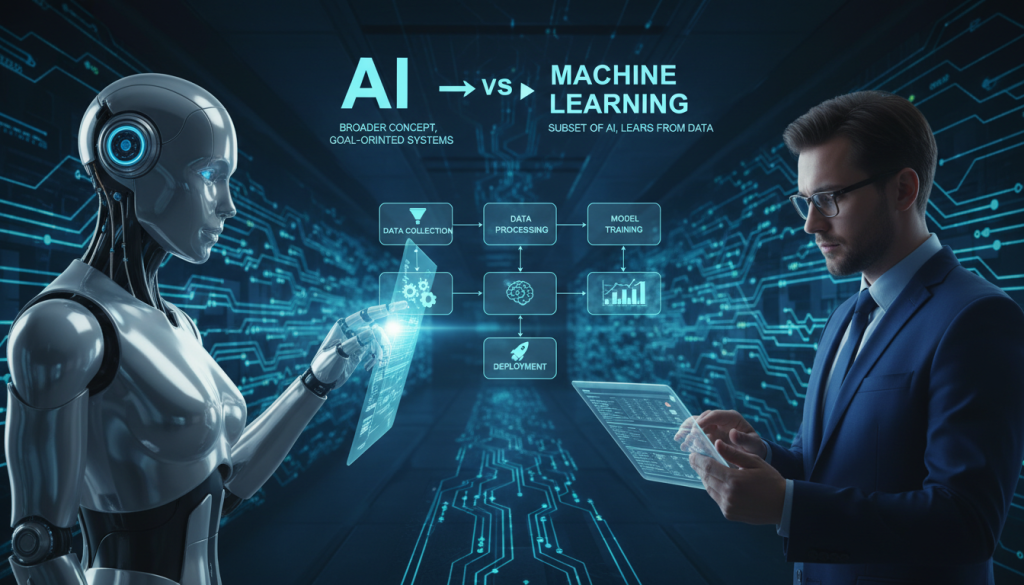
In everyday work, teams follow a process with ML. First, they collect data and choose a goal. Then, they train and test a model before using it live. After starting, they keep an eye on changes in real-world behavior. They retrain the model to keep its performance good.
Explanation of Machine Learning
At its heart, ML is about finding patterns and improving from feedback. A model predicts, its accuracy is checked, and then it’s updated to perform better. Because of this learning loop, ML gets better over time without needing code changes.
It’s useful to know how ML is different from generative AI. Generative AI often uses a kind of ML called deep learning, designed for big tasks. But many ML applications don’t create new content. They focus on things like evaluating credit risks or spotting strange logins.
Categories of Machine Learning
ML mainly falls into a few types, depending on the data and feedback used. This helps explain AI vs ML by showing ML’s capabilities, even without mimicking humans.
- Supervised learning uses data with clear labels to predict outcomes, such as telling spam from not-spam or estimating house prices.
- Unsupervised learning explores data without specific labels to uncover its structure, helping in grouping customers or reducing data dimensions.
- Semi-supervised learning combines a bit of labeled data with a lot of unlabeled data, useful when labeling is hard or costly.
- Reinforcement learning rewards or penalizes an AI agent, useful in robotics, gaming, and solving specific problems.
| ML category | What the model learns from | Typical tasks | Clear product example |
|---|---|---|---|
| Supervised learning | Labeled inputs paired with known outputs | Classification and regression | Email spam filtering; predicting delivery times for an online order |
| Unsupervised learning | Unlabeled data with no specific goals | Clustering and dimensionality reduction | Targeting specific customer groups in e-commerce |
| Semi-supervised learning | A bit of labeled data plus lots of unlabeled data | Sorting with some known information | Sorting large photo collections with some tagged images |
| Reinforcement learning | Feedback from actions over time | Learning policies and making sequences of decisions | Guiding robots in warehouses; developing game strategies |
Applications of Machine Learning
ML is part of everyday products. For example, recommendation systems suggest what to watch next, like Netflix does, and also recommend products. It’s a common way to see ML in action, as the outcomes are direct and measurable.
In computer vision, ML checks quality on production lines and flags problems in medical scans for doctors. It also powers tools for understanding language, helping with sentiment analysis, sorting documents, and summarizing for customer service and researchers.
Another big use is spotting fraud and odd behavior. Payment and security systems look for unusual patterns to assess risks. This focus on error detection, loss prevention, and model updating is central to understanding AI vs ML.
Key Differences Between AI and Machine Learning
People often confuse the terms AI and machine learning in everyday conversations. A clear comparison of AI and machine learning shows what each excels at. It makes understanding their differences both practical and easy.
Scope and Definition
Artificial intelligence (AI) is the wider concept aimed at creating smart-acting software. This includes reasoning, planning, and interacting. Machine learning falls under AI, learning from patterns in data.
Think of AI as the goal, with machine learning as a key way to get there. This idea simplifies understanding their differences when looking at tools and resources.
Core Objectives
AI focuses on mimicking intelligent actions like decision-making and adapting. Some AI systems use rules and logic to stay consistent and clear.
Machine learning aims to get better results, focusing on accuracy and other key performance indicators. The main divide in comparison is logic versus pattern improvement.
Technology and Techniques Used
AI doesn’t always need machine learning, using methods like rule engines and expert systems instead. These work well for tasks with fixed rules and the need for clear documentation.
Machine learning involves statistical methods like regression and neural networks. Deep learning, a type of neural network, is especially good for working with text and images.
| Decision lens | AI approaches that may fit | ML approaches that may fit |
|---|---|---|
| Rules are stable and must be explainable | Rule engines, expert systems, knowledge graphs | Interpretable models like logistic regression when data adds value |
| Patterns are complex and data is available | Hybrid AI that wraps workflows around predictions | Random forests, XGBoost, neural networks, deep learning |
| Operational planning with constraints | Constraint solvers for scheduling and routing | ML for demand forecasts that feed the solver |
| Need for consistency across edge cases | Symbolic logic and validation rules | ML with monitoring to manage drift and rare failures |
Many today’s “AI” features actually rely on machine learning, though the names are often used interchangeably. Remembering this distinction helps teams decide on approaches and understand differences when picking solutions.
The Relationship Between AI and Machine Learning
Think of artificial intelligence as a big umbrella. Below it, machine learning and deep learning are nestled. Imagine AI and machine learning as tools ranked by functionality, not by how they’re marketed.
You might use AI or machine learning every day without realizing it. Your email’s spam filter, the maps you use, and voice helpers all use them. They blend learning from data with following specific rules.

How Machine Learning Fits into AI
Machine learning helps AI deal with real-world chaos. It learns patterns from examples, getting better as it gets more feedback. This is key because coding rules for every possible variant, like accents or lighting, is tough.
AI excels in recognizing and predicting things thanks to machine learning. Computer vision identifies items in pictures. Language processors sort help desk tickets. And suggestions systems customize what you watch or buy online.
| Layer | What it does | Where you see it in products |
|---|---|---|
| Artificial intelligence (AI) | Goals and behaviors that seem “smart,” using rules, search, or learning | Route planning in Google Maps, fraud alerts in banks, customer support triage |
| Machine learning (ML) | Learns from data to predict, rank, classify, or detect patterns | Email spam detection, demand forecasting, personalized feeds |
| Deep learning | Neural networks that learn features from large datasets, often for vision and language | Face grouping in Apple Photos, speech recognition, image search |
Other Subfields of AI
AI is more than just ML. It includes natural language processing, which combines machine learning and older methods. Teams often use both to make sure chats make sense.
Computer vision mainly uses deep learning now, which is good at identifying and outlining objects. Robotics combines control, sensing, and planning for action in the real world. And knowledge systems use logic and rules to organize and explain data.
Planning and optimization are crucial too, even with less learning. They help airlines schedule staff, warehouses pick routes, and factories manage work. Understanding AI means seeing the role of these math and rules areas.
The Importance of Data
Machine learning depends heavily on its data. Quality and representation in data are as key as the algorithms used. If the data is off, the predictions will likely be as well.
Even for non-learning systems, data is vital through databases, policies, and rules. Managing data is often the tricky part of AI. How you gather, label, and maintain data affects the system’s reliability and performance over time.
Common Misconceptions about AI and Machine Learning
Many teams focus too much on what to call it rather than what it does. In the AI vs. machine learning discussion, the names often mix up. This is because “AI” is a broad term used for all things automated. Understanding the myths helps you choose the best strategy and have the right expectations.
AI and Machine Learning are the Same
AI and machine learning are related, but different. Think of AI as the overall goal – creating systems that act intelligently. Machine learning is a method to achieve that goal.
Product descriptions can make things confusing. A feature might be labeled “AI” even if it’s based on simple rules, a formula, or a model that doesn’t learn after its first use.
| What you see in products | What it often means | Why the label sticks |
|---|---|---|
| “AI-powered recommendations” | A trained model ranks items, or a rules list sorts by clicks and recency | “AI” suggests innovation, even with basic logic |
| “Smart routing” in support tools | Uses if/then rules, keyword matching, or a simple classifier | Buyers are looking for speed, not a lesson in tech |
| “AI detection” or “AI scoring” | Based on thresholds, rules, or a fixed model | The term “AI” fits many methods, making it easier to market |
AI Always Involves Machine Learning
That’s not always true. In debates on AI vs. machine learning, ML is just one set of methods. Some AI works on clear, human-made rules that don’t change.
- Rule-based chat flows follow preset paths
- Expert systems use rules to simulate expertise
- Deterministic optimization looks for the best plan within limits
- Constraint-based scheduling is used in staffing and planning
- Knowledge-graph reasoning connects points to make structured conclusions
Machine Learning Requires Huge Amounts of Data
Lots of data can help, but you don’t always need a ton. The choice between AI and machine learning depends on the problem, potential errors, and if patterns stay the same.
Even with little data, the right approach can work wonders:
- Transfer learning adjusts known models for new tasks
- Classical models work on structured data, like predicting churn
- Synthetic data can help, if used and checked wisely
Less data might mean focusing on simpler models and being more cautious. With more data, results can get better, but concerns about privacy, costs, and control also increase.
The Role of Data in AI and Machine Learning
Data powers AI and machine learning, making them work in the real world. Often, when discussing AI and machine learning, data is the key many forget. The distinction between AI and ML largely depends on the ways data is collected, processed, and utilized.

How Data Powers Both Technologies
In machine learning, data trains the system to recognize patterns and improve. It adjusts the model to work better with new information. But, if the data isn’t good, results can seem accurate in tests but fail when actually used.
Data also underpins broader AI systems, from filling databases to aiding in searches. Teams often use information from documents to help AI respond to queries. This shows the difference: machine learning learns from data, while AI uses data to inform decisions.
Types of Data Used
Companies use different types of data, each with its costs and privacy issues.
| Data type | Common U.S. business sources | Typical AI/ML use | Main prep need |
|---|---|---|---|
| Structured | Salesforce CRM records, ERP invoices, claims tables | Forecasting, churn scoring, anomaly detection | De-duplication, consistent IDs, missing-value handling |
| Unstructured | PDF contracts, emails, chat transcripts, call notes | Search, summarization, classification, RAG retrieval | Text cleaning, chunking, access controls |
| Semi-structured | JSON events, app logs, clickstreams | Fraud signals, monitoring, recommendation features | Schema mapping, time alignment, parsing |
| Audio/Image/Video | Contact center recordings, inspection photos, security footage | Speech analytics, defect detection, content moderation | Labeling, compression strategy, consent management |
| Sensor/IoT | Fleet telematics, manufacturing sensors, smart meters | Predictive maintenance, real-time alerts | Noise filtering, sampling strategy, drift checks |
Data Quality and Its Impact
Problems like biased samples and label noise can spoil results, showing “garbage in, garbage out.” Missing or outdated data can make recent trends useless. This highlights another aspect of AI versus ML: errors in ML come from poor training data, while AI failures often stem from bad retrieval or old data.
Teams focus on preventing issues with data through constant monitoring and updates. They check for changes and maintain records of data use and approval. Fairness is also key: if any groups are overlooked, the results may be uneven, causing issues not seen until complaints are made. Thus, when explaining AI versus ML, it becomes a story about data’s importance in achieving reliable outcomes.
Benefits of Implementing AI and Machine Learning
Teams use AI or machine learning to reduce busy work, make smarter choices, and better customer experiences. Choosing the right method and using clear KPIs to track progress gives the best results.
Some organizations start with rule-based automation for consistent results. Others use models that learn and get better as data changes. Usually, a mix of both is used, with human checks where they’re most needed.
Enhanced Efficiency and Productivity
AI and machine learning can take over tasks like sorting documents, sorting tickets, and summarizing meetings. This makes processes faster and lets people focus on more important work.
They make a big difference in customer support. Systems can draft replies, sort issues, and find past cases quickly. With human-in-the-loop oversight, agents handle more with less mistakes.
- Lower cost-to-serve through faster handling and smarter routing
- More operational throughput during peak demand
- Less rework from consistent formatting and checks
Improved Decision-Making
Predictive tools are great for forecasting demand, predicting churn, and spotting fraud. Machine learning adapts well to new data but needs watching to stay on track.
These tools give likely outcomes, not guarantees. Teams need to set clear rules and review steps to keep decisions understandable and safe.
Good forecasting doesn’t replace judgment; it makes judgment faster and more consistent.
Greater Personalization
Personalization affects suggestions, content, search results, and site layouts. AI and machine learning adjust what users see to their interests and past actions.
Still, personalization has limits. It’s important to respect privacy, get consent, and explain things clearly to keep trust and improve results.
| Benefit area | Typical capabilities | Best-fit approach in an AI and machine learning comparison | KPIs to track |
|---|---|---|---|
| Efficiency | Document processing, ticket routing, summarization, workflow automation | Rule-based AI for consistency; AI or machine learning for flexible classification and drafting | Time saved, cost-to-serve, operational throughput, error reduction |
| Decision support | Forecasting, churn prediction, fraud detection, risk scoring with alert thresholds | Machine learning for pattern discovery; rules for clear audit trails and controls | Forecast accuracy, false-positive rate, loss prevented, review turnaround time |
| Personalization | Recommendations, ranking, next-best action, adaptive UX | Machine learning for relevance; rules to enforce privacy limits and policy constraints | Conversion rate, repeat visits, CSAT, opt-out rate, complaint rate |
Challenges Facing AI and Machine Learning
Strong teams often face tough challenges when they start working on real systems instead of just demos. The common debate between Artificial intelligence and machine learning doesn’t fully address everyday issues like governance, risk, and inaccurate results. In both AI and machine learning projects, the goals are to work quickly, safely, and accurately.

Ethical Considerations
Biases can sneak into systems in many ways, like through the data used for training or when deciding how to label information. This can lead to unfair results in important areas such as job hiring, loans, and managing health. When working with AI and machine learning, we have to be very careful to treat people fairly.
It gets complicated to figure out who is responsible when things go wrong. For instance, if a system wrongly denies someone a benefit or labels them as a risk, there should be clear rules on who checks and fixes these mistakes. Transparency is also key, as it can be tough to explain how these systems make their decisions.
There’s also a danger of trusting these systems too much. If their predictions look too convincing, people might stop double-checking them. A smarter approach is to use machine learning outputs as helpful advice that needs to be confirmed.
Data Privacy Issues
In the US, privacy concerns often begin with how personal data is collected, such as from apps, calls, or devices. AI and machine learning projects must have strong privacy rules to control who can see data, how long it’s kept, and when it should be deleted.
Even making data anonymous isn’t a perfect solution. If different datasets are combined, it’s possible to figure out who the data belongs to. Proper management is crucial and should include things like who can access data, encrypting data, how long it’s kept, and keeping detailed records of data use.
Technical Limitations
Machine learning models can break if things change, like a new economic situation or different types of fraud. While planning AI and machine learning projects, teams should prepare for changes in data and set aside resources for updates and improvements.
Another problem is that these systems can make up information. This can be dangerous in important areas like customer service or healthcare. Some systems may also react poorly to small, misleading changes in the information they receive.
Sometimes, simpler models are easier to explain but might not work as well as more complex systems. Many teams use a variety of approaches to balance understanding and performance. This includes straightforward models for explanation, thorough testing, and automation in carefully chosen areas.
Integration often causes delays. Obstacles like data stuck in different places, outdated technology, and poor practices can slow down or stop projects. Successful projects include thorough testing, preparation for potential problems, monitoring, and plans to address issues quickly.
| Challenge area | What it looks like in practice | High-level safety and compliance practices |
|---|---|---|
| Bias and fairness | Different error rates across groups; uneven service quality; harmful edge cases | Stratified testing, fairness metrics, documented data sources, regular audits |
| Accountability | Unclear owner for automated decisions; slow escalation when harm occurs | Defined decision rights, human review for high-stakes outcomes, audit trails |
| Privacy and governance | Over-collection, long retention, and risky vendor sharing of personal data | Access controls, encryption, retention limits, de-identification checks, vendor reviews |
| Model reliability | Performance drops after market shifts; unstable results across regions or seasons | Continuous monitoring, drift detection, scheduled retraining, rollback plans |
| Generative model risk | Hallucinated answers; inconsistent tone; policy-violating content under pressure prompts | Red-teaming, output filters, grounded retrieval, human escalation paths |
| Operational maturity | Data silos, legacy integration, weak release controls, limited incident response | MLOps pipelines, change management, logging, alerting, post-incident reviews |
The Future of AI and Machine Learning
Predicting the future can seem like an AI vs ML debate. However, teams focus on practical benefits. These include quicker service, safer choices, and sharp insights. When comparing AI and machine learning, the future prefers options that are trustworthy, measurable, and easy to manage.
Trends to Watch
Multimodal models are now becoming part of our daily routine. They handle text, pictures, and sound. This supports teams in many areas like customer service and work in the field. Now, whether AI or machine learning is better includes looking at handling different types of data.
AI is also moving closer to users, right onto devices. This means faster results and keeping private info secure. This shift changes the AI vs ML discussion. Now, where you put the AI is as important as how accurate it is.
There’s a rise in systems that plan and execute tasks on their own. They need strict rules and ways to check what they do. There’s a move towards models made for specific industries. They use real data from companies, making AI and machine learning comparisons focus on being dependable.
Potential Impact on Industries
Healthcare could see improvements in how things run and keeping records accurate. Finance might get stronger at checking risks and following rules, especially when clear thinking is needed. Retail can offer more personalized service and get better at predicting needs and managing supplies.
Manufacturing may boost its inspection quality and predict when machines will need fixing, cutting downtime. Education could use tools to help with writing, tutoring, and course management, but still leave learning aims to people. Here, choosing between AI and ML depends on the task: broad thinking or specific forecasting.
| Trend | Why it’s growing | Where it shows up first | What leaders should measure |
|---|---|---|---|
| Multimodal models | One system can interpret mixed media for faster decisions | Customer support, marketing review, field service | Error rate by input type, review time, user satisfaction |
| On-device/edge AI | Lower latency and stronger privacy control | Retail checkout, mobile apps, factory sensors | Latency, battery/compute cost, data exposure risk |
| Agentic workflows with guardrails | Automation expands from answers to actions | IT ops, reporting, procurement support | Task success rate, tool-call logs, safety incident rate |
| Industry models + retrieval grounding | Outputs align better with policies and source material | Healthcare admin, legal ops, finance compliance | Source coverage, citation accuracy, policy adherence |
Job Market Implications
Work will change more than vanish. Many jobs will automate routine tasks. This lets people focus on decision-making and building relationships. When comparing AI and machine learning in planning for jobs, it’s wise to look at specific tasks.
New job areas are appearing, like AI product managing, data rules, and risk managing of models. There’s a push towards understanding data better, along with designing tasks and testing them. Laws, standards, and earning trust will greatly influence how quickly these changes occur and their impact.
AI vs. Machine Learning in Business
In business, choosing between AI and machine learning is common. Leaders seek quicker service, less mistakes, and improved planning. It’s useful to understand the difference between AI and machine learning. AI is for automating decisions with set rules. Machine learning finds patterns in data to predict outcomes.

Use Cases in Various Industries
Retail and online shops use machine learning for suggesting products, predicting sales, and setting prices. AI helps guide customers to the right support with chat systems. It’s helpful to know when to use automation or prediction.
In the banking and insurance fields, machine learning helps with spotting fraud, supporting decisions, and sorting claims. AI checks for policy rules and steps needed for compliance. Understanding their differences is key: AI for rules, machine learning for risks.
Logistics teams predict delivery times and plan routes better with machine learning. AI manages warehouse alerts and assigns tasks. For media and marketing, there’s help with sorting audiences and making content fit brand guidelines.
| Industry | AI-focused wins (rules, automation) | Machine learning-focused wins (prediction, patterns) | Typical KPI to track |
|---|---|---|---|
| Retail / E-commerce | Customer support routing, returns workflow automation | Recommendations, demand forecasts, pricing sensitivity signals | Conversion rate, stockout rate |
| Banking / Insurance | Compliance checks, document intake, policy rule enforcement | Fraud scoring, underwriting support, claims prioritization | Loss rate, time-to-decision |
| Logistics | Exception alerts, dock scheduling, task orchestration | ETA prediction, route optimization, capacity forecasting | On-time delivery, cost per shipment |
| Media / Marketing | Brand-safe rules, approval workflows, content routing | Segmentation, propensity models, content classification | CPA, engagement rate |
Cost-Benefit Analysis
Costs appear early with data handling and computing needs. Integration, security checks, and staff are important costs too. Keeping an eye on system performance is essential as customer habits shift.
The benefits come as less manual work, reduced mistakes, and quicker choices. Teams often start with small tests to show value before big launches. Fast ROI in AI vs machine learning happens by focusing and measuring results properly.
Choosing the Right Technology
AI works well when rules don’t change much. If you need to predict or detect, machine learning is usually better. Asking about the difference between AI and machine learning helps focus on the need, not just trendy terms.
Before deciding, follow a simple list:
- Data availability: Make sure you have enough good data for training models.
- Explainability: People might need simple explanations, like auditors or customers.
- Risk level: Think about the impact of errors and how to catch them.
- Latency needs: Decide if the system must work in real-time or can wait.
- Maintenance capacity: Plan who will keep the system up to date.
Choosing vendors also impacts AI vs machine learning decisions. Look for detailed documentation, test results, and clear update plans. This helps manage quality and changes as the technology grows.
Popular Tools and Frameworks for AI and Machine Learning
Picking the right tools becomes simple when you understand AI and ML practically. Some tools are for creating AI features, others for training models with data. Understanding AI and machine learning in simple words also stops teams from getting tools they won’t use.
Overview of AI Tools
In the U.S., many teams find cloud platforms the quickest way to start projects. AWS helps from start to finish with Amazon SageMaker and options like Bedrock. Google Cloud Vertex AI and Microsoft Azure AI also offer key resources for training and managing models.
Databricks is central for analytics and ML in data-focused companies. Snowflake is crucial too, especially for teams focusing on governance and connecting to ML tools. In real work, the difference between AI and ML often depends on data location and project speed.
Generative AI introduces more options. Teams often choose OpenAI APIs or Anthropic for tasks like chatting and summarizing. Pinecone and Weaviate are popular for search and ranking, offering specific solutions for finding and organizing information.
Leading Machine Learning Frameworks
Scikit-learn is a top choice for quick, straightforward projects and testing ideas. XGBoost excels with clear data structures, offering precise results quickly. Starting with these makes explaining AI and machine learning simpler because you can easily see how it works.
PyTorch and TensorFlow are leaders in deep learning, great for vision and language tasks. They suit teams wanting custom setups or large experiments. Tools like MLflow and Kubeflow organize work, track experiments, and ensure models are easy to deploy repeatedly.
Comparative Analysis of Tools
| Need | Best-fit tools | Why it fits | Trade-offs to watch |
|---|---|---|---|
| Fast baseline on structured data | scikit-learn, XGBoost | Clear features, strong results on tabular prediction, quick training cycles | Less flexible for unstructured data like images and raw text |
| Vision or NLP with deep learning | PyTorch, TensorFlow | Custom models, GPU support, large ecosystem for research-to-prod | More tuning, higher compute cost, steeper learning curve |
| Managed training and deployment | Amazon SageMaker, Google Cloud Vertex AI, Azure Machine Learning | Hosted endpoints, monitoring hooks, easier scaling for production traffic | Vendor lock-in risk, billing complexity, latency varies by region and setup |
| GenAI with grounded answers | OpenAI APIs, Anthropic models, Pinecone, Weaviate | Strong generation plus retrieval patterns for policy and support content | Data handling rules, prompt drift, and governance need steady attention |
| Experiment tracking and model lifecycle | MLflow, Kubeflow | Reproducibility, deployment workflows, clearer handoffs across teams | Setup effort, platform skills required, operational overhead |
Choosing tools is easier when you know the kind of problem: NLP, vision, or prediction. It must also fit your team’s abilities, budget, speed goals, and rules needs. With this focus, talking about AI and machine learning is practical. And the talk about AI versus ML becomes a helpful guide, not just a debate.
How to Get Started with AI and Machine Learning
It’s simpler to start when you know your target. Knowing the difference between AI and machine learning guides you. It helps you choose your direction, tools, and projects. People often mix AI and ML. This can be confusing. A clear goal helps you stay on track.
Essential Skills Needed
Start with important math: basic statistics, probability, and linear algebra concepts. Pair this math with Python, the go-to language for AI and ML.
Then, improve your data skills. Learn SQL to access clean data. Practice data cleaning, exploring data, and making it useful. These skills are often more crucial than fine-tuning models.
Learn to create models. Focus on training, testing, and avoiding common pitfalls. Be good at evaluating your models and explaining the results.
Lastly, know how to share your work. Understanding Git, APIs, Docker, and monitoring will make your projects accessible and shareable.
| Skill Area | What to Practice | Why It Matters | Starter Outcome |
|---|---|---|---|
| Math foundations | Mean/variance, Bayes basics, vectors and matrices | Builds intuition for how models learn and fail | Explain why one metric improves while another drops |
| Programming | Python, functions, debugging, notebooks | Keeps experiments fast and repeatable | Run a full pipeline from data load to evaluation |
| Data work | SQL, cleaning, EDA, feature engineering | Good inputs beat fancy algorithms | Create a dataset you trust and can reproduce |
| ML practice | Cross-validation, regularization, metrics, interpretability | Prevents misleading results in AI vs ML projects | Compare models with a fair test setup |
| Deployment awareness | Git, simple REST APIs, Docker basics, monitoring | Makes your work usable outside a notebook | Package a model and track performance over time |
Online Resources and Courses
For learning with structure, check out Coursera and edX. They offer courses for theory and hands-on practice. Stanford Online also offers materials on AI and ML. These come with clear examples.
If you want to dive in quickly, the Google Machine Learning Crash Course is great. Another choice is fast.ai, which helps learners start building fast. For those who prefer to start with the basics, check scikit-learn, PyTorch, and TensorFlow guides.
Tips for Beginners
Start with a small project to finish in a weekend. Try making a spam filter, prediction model, or a simple recommender. This teaches you the cycle without being overwhelming.
Use public data from Kaggle or the UCI Machine Learning Repository. Track your work carefully. Save every step, assumption, and result to keep track of your progress.
- Check basics early: split data correctly, choose a metric, and confirm your baseline.
- Learn responsible habits: do quick bias checks, respect privacy, and document data sources.
- Build a portfolio that reads well: show problem framing, evaluation, and iteration, not just model training.
With time, AI and ML will become clearer as you practice. Understanding their differences will be a valuable skill for real projects.
Conclusion: The Takeaway on AI and Machine Learning Differences
In simple terms, AI is our big goal. It aims to create systems that seem smart. Machine learning helps achieve this by learning from data. If you’re wondering about the difference between AI and machine learning, think of it like an umbrella and a tool. AI might use machine learning, but it can also depend on rules, logic, and expert systems.
Summarizing Key Points
The debate between AI and machine learning often focuses on decision-making methods. Rule-based AI follows specific steps, making it easier to understand during reviews. Machine learning, on the other hand, spots patterns, gets better with feedback, and constantly needs checks to stay on track.
The Importance of Understanding Both
For many teams in the U.S., knowing the difference affects budgets, timelines, and risks. Go for AI (rules and automation) when you need clear logic and must meet strict rules. Opt for ML for its ability to handle complex patterns and its adaptability to changing conditions.
Final Thoughts on the Future
The lines between AI and machine learning will continue to blur. This might make it harder to tell them apart when you’re making decisions. Yet, the key will be in how we handle data, check our work, and deploy systems responsibly. When asked about the difference between AI and machine learning, we should focus on their impact. We want systems that earn trust, prove their worth, and are well managed in real life.