
Is your business finding it hard to keep up with email marketing demands while keeping it personal? The answer is artificial intelligence.
Yes, AI email automation has changed how businesses run their campaigns. Today’s platforms use smart algorithms and natural language to send messages. This tech makes sure each message goes to the right person at the best time.
Numbers show the power of AI in email marketing. Outbound email volume went up 15% last year, thanks to better customer engagement. Email is the top choice for people to interact with brands.
Platforms like Mailchimp have sent over 3.1 billion messages with AI content. Companies using AI email automation see returns up to 25 times their investment. These platforms analyze data, sort audiences, and plan delivery times on their own.
This change lets marketing teams work on big ideas while tech handles the details. Machine learning gets better with each campaign, improving results over time.
Key Takeaways
- Artificial intelligence successfully automates and scales email campaign creation and distribution
- Machine learning algorithms personalize content and optimize send times for maximum engagement
- Over 3.1 billion AI-generated messages have been sent through major platforms
- Businesses achieve up to 25x return on investment using automated email solutions
- Outbound email volume grew 15% last year due to high customer engagement rates
- Automation allows teams to focus on strategy while technology manages execution
Understanding AI in Email Marketing
Email marketers today face a big challenge. AI is here to help by making personalized experiences for thousands of subscribers at once. AI email marketing uses advanced algorithms and data analysis to make each message feel special for each person.
Modern marketing platforms have AI built right into them. These tools quietly analyze data and make decisions that would take humans weeks. This leads to automated email campaigns that get better with every send.
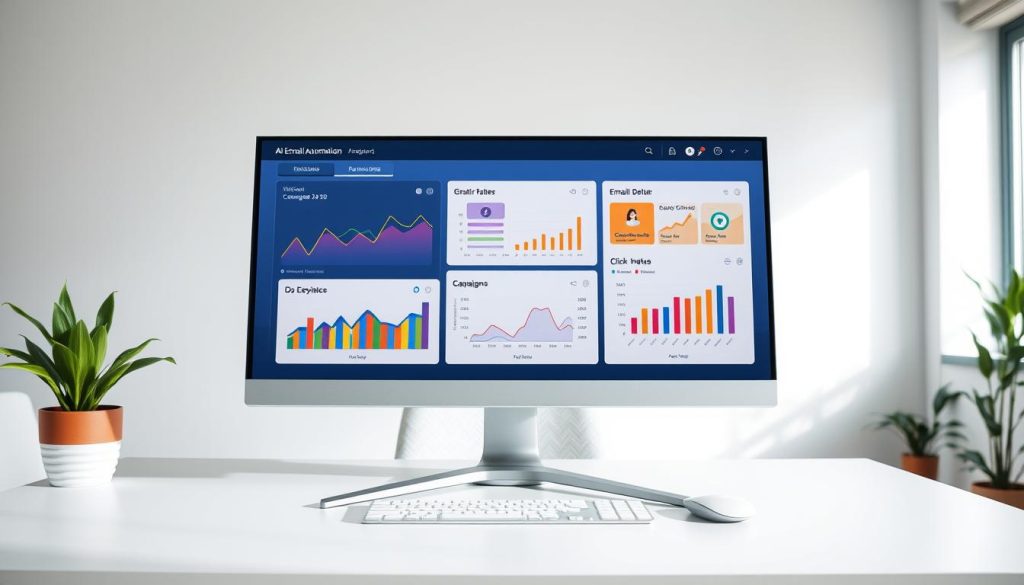
The Technology Powering Smart Email Campaigns
AI in email marketing uses two main technologies. Predictive AI looks at past data to guess what customers will do next. It checks past campaigns, website visits, and purchases to make smart guesses.
Generative AI creates new content for each user. It writes subject lines, email copy, and suggests products. Both work together in platforms like Mailchimp and Salesforce to automate email marketing.
Machine learning algorithms keep learning from how customers react. They look at which campaigns work best and improve them automatically. This creates a cycle of constant improvement.
Lead scoring is another key part of AI in email marketing. It gives scores to subscribers based on how likely they are to buy. This helps marketers focus on the most promising leads.
Tangible Advantages for Marketing Teams
AI in email campaigns offers more than just saving time. It boosts results and lets marketing teams focus on big ideas, not small tasks.
Personalization at scale is a big win. AI tailors messages to each subscriber based on their behavior and preferences. This level of customization was hard to do by hand, but AI makes it easy for big companies.
- Improved engagement metrics: AI campaigns get better open and click rates by timing and personalizing messages
- Enhanced conversion rates: Personalized content leads to more actions, like buying or downloading
- Advanced customer segmentation: AI lets marketers create detailed segments based on small differences in behavior
- Reduced manual workload: Automation handles tasks like list management and reporting, freeing up time for creativity
- Expanded audience reach: AI finds similar prospects to best customers, helping reach more people
AI also predicts how much value each customer might bring. It looks at how often they buy, how much they spend, and how engaged they are. This helps teams focus on nurturing valuable relationships.
AI is great at optimizing send times for each subscriber. It figures out when each person is most likely to open an email. This can greatly improve campaign results without extra work from marketing teams.
AI email marketing tools do more than save time. They change how campaigns work. They make decisions fast and at a scale that humans can’t match. When used right, AI is a powerful partner that boosts marketing team abilities, not replaces them.
How AI Generates Bulk Emails
AI email campaigns start with a detailed process. They turn customer insights into messages that speak to each person. This way, marketers can send lots of emails that feel personal, which boosts engagement.
An AI email generator doesn’t send the same message to everyone. It creates emails that match what each customer likes. This mix of creativity and innovation makes messages that really connect with people.

The Process Behind AI Email Generation
The first step is data collection from various sources. AI gathers info from CRM systems, past interactions, and website visits. This data helps build detailed profiles of each subscriber.
After collecting data, AI sorts customers into groups based on their interests. It finds out which products each group likes and when they’re most active. This helps tailor messages to each group.
The real magic happens in content creation. AI writes email copy, subject lines, and calls-to-action for each group. It makes the content feel like it was written by a person, while also being effective.
For example, a clothing retailer can start with one email about product recommendations. Then, the AI quickly makes ten new versions for different groups. Each version is tailored to fit what each group likes.
Let’s say one version focuses on eco-friendly products for green shoppers. Another version highlights the latest fashion trends for style enthusiasts. This shows how AI can personalize emails for many people at once.
Overview of Algorithms Used
Many algorithms work together in AI email generation. Each one does a specific job to make emails effective. Knowing about these algorithms shows how advanced AI personalization is.
Machine learning algorithms are the base of AI email systems. They learn from customer actions, getting better over time. Every interaction helps the system understand what works for different people.
Natural language processing (NLP) lets AI write like a human. It looks at successful emails to find patterns that engage people. NLP makes sure the content is right, in tone and structure.
Predictive analytics algorithms figure out the best time and content for each person. They use past data to guess when someone will open an email and what will get a response. This makes campaigns more effective.
Deep learning models find complex patterns in customer behavior. These neural networks look at lots of data to find hidden connections. This helps create more detailed and personalized messages.
| Algorithm Type | Primary Function | Key Benefit | Application in Email Marketing |
|---|---|---|---|
| Machine Learning | Continuous learning from interactions | Improves accuracy over time | Predicts customer preferences and refines targeting |
| Natural Language Processing | Understands and generates text | Creates human-like content | Generates subject lines, body copy, and CTAs |
| Predictive Analytics | Forecasts optimal timing and content | Maximizes engagement rates | Determines best send times and offer types |
| Deep Learning | Identifies complex behavioral patterns | Enables advanced segmentation | Creates micro-segments for hyper-personalization |
Together, these algorithms make a powerful system for personalized emails. Generative AI uses predictive AI to create new content for each user. This lets marketers send emails that really speak to each person.
Generative AI is where “creativity meets innovation and personalization takes center stage.”
This technology can create many versions of a message, each tailored to a specific group. The AI email generator saves time and makes sure each email is engaging. Marketers can focus on strategy, knowing the system will handle the details.
Advantages of Using AI for Bulk Emails
Using AI for email marketing gives businesses a big edge. It changes how they talk to lots of people at once. AI makes emails more personal, efficient, and profitable than old ways.
Marketers need to do more with less and keep real connections with customers. AI helps by doing hard tasks and making emails better. Companies see big jumps in how people interact with their emails and how much money they make.

Enhanced Personalization
AI email personalization is more than just using someone’s name. It uses data from CRM systems to make emails just for each person. This was hard to do before.
AI finds out how people like to get emails. It can sort people based on what they look at online, what they buy, and how they interact with emails. This means emails are really about what each person wants.
AI-powered personalization creates inclusive customer experiences. It makes sure emails are right for everyone, not just one way. So, someone who likes sports shoes gets different emails than someone who likes fancy shoes. The tone of the emails also changes based on how people have interacted with them before.
Personalization at scale is no longer a luxury—it’s a necessity for businesses that want to remain competitive in crowded inboxes.
When emails are really about what people want, they do better. People click on emails more, buy more, and stay with brands longer. This means more money for businesses.
Increased Efficiency and Productivity
AI makes tasks that took a lot of time easy. It sorts people, makes content, picks the best times to send emails, and checks how well emails do. Bulk email tools with AI save thousands of hours. This lets teams focus on new ideas and creative work.
One marketer said A/B testing got 10x better with AI. This means teams can try lots of different things fast. They can test different looks, calls to action, and messages.
The benefits of AI last throughout the whole email process:
- Automated sorting of people based on what they do online
- Content made just for certain groups of people
- Best times to send emails picked by AI
- Constant checking of how well emails do and suggestions for better ones
- AI finds chances to make more money before others do
AI helps small teams do big things. They can do complex campaigns that used to need big teams. This means more time for planning and coming up with new ideas.
Cost-Effectiveness
The money saved with AI email personalization is huge. Some users have seen up to 25x return on investment. This is because more people buy things when emails are right for them, and it costs less to find those people.
Old ways of email marketing take a lot of people to do. AI makes these tasks easier and better. This means businesses save money and make more, fast.
AI also helps keep customers coming back. When people get emails that really matter to them, they like the brand more. They buy more, tell friends, and stay longer. This means more money over time.
AI saves money and makes more, so businesses make a lot of money back. Most see positive returns in just a few months. As AI learns more, it gets even better at helping businesses.
Key Features of AI Email Tools
AI-powered email tools do more than just send messages. They automate, test, and analyze to help marketers create better campaigns. These tools turn email marketing into a strategic, data-driven process.
AI email platforms offer three main features. These features solve specific marketing challenges and help campaigns succeed. Together, they form a complete solution for businesses of all sizes.
Automation Capabilities
Email tools start with easy-to-use automation. Send-time optimization picks the best time to send emails based on past behavior. This ensures messages reach subscribers when they’re most likely to engage.
Another key feature is content selection. The system picks the right offers and messages for each group based on their past actions. Subject line testing also runs automatically to find the most compelling options.
Marketers can move from basic to advanced automation as they grow. They can create different versions of emails for various customer groups. This way, each group gets messages that match their interests and stage in the buying process.

Real-time personalization takes automation further. It adjusts email content based on what customers do right away. This could be adding items to their cart or browsing products. Personalized campaigns then address these actions, making emails more relevant and effective.
A/B Testing Functionality
Old A/B testing mainly focused on subject lines. Now, AI tools test many aspects. User behavior patterns are also tested to see how different approaches work for different groups.
AI also tests visual elements like images and colors. It finds out which designs and colors appeal most to the audience. Call-to-action placement, wording, and design are tested too, to find the best way to engage people.
The big advantage is continuous learning, not just one-time testing. AI keeps improving campaigns based on ongoing results. This ensures strategies stay effective as audience preferences change.
Testing goes beyond just visuals. Marketers can test different email layouts and how information is presented. Each test adds to the data, helping make better decisions with every email sent.
Analytics and Reporting
AI analytics do more than track basic metrics. Campaign Pipeline Analytics looks at meaningful business outcomes. It reports on things like Opportunities created and Revenue driven by campaigns.
AI tools also integrate with customer data platforms. They pull data from various sources like email engagement and purchase history. This gives a complete view of customer interactions, revealing patterns and trends missed by single-channel analytics.
AI analyzes preferences across all email data and connects insights from other touchpoints. It finds out which content types engage the most, which segments convert best, and which campaign elements drive revenue. These insights help make data-driven strategy adjustments to improve results over time.
Reporting dashboards show data in ways that help make quick decisions. Marketers can dive deep into campaign performance, segment details, or customer behaviors. This flexibility lets teams get the exact insights they need for optimization.
| Feature Category | Key Capabilities | Primary Benefits | Skill Level Required |
|---|---|---|---|
| Automation | Send-time optimization, content selection, real-time personalization, multi-variant emails | Reduced manual work, increased relevance, timely engagement | Beginner to Intermediate |
| A/B Testing | Subject line testing, behavioral analysis, visual element testing, continuous learning | Data-driven decisions, improved performance, ongoing optimization | Intermediate |
| Analytics | Pipeline tracking, CDP integration, cross-channel analysis, revenue attribution | Business outcome visibility, unified customer view, strategic insights | Intermediate to Advanced |
| Integration | CRM connectivity, data platform syncing, API access, workflow automation | Seamless operations, enhanced data quality, scalability | Advanced |
These features work together to create a complete email marketing solution. Automation handles repetitive tasks and ensures timely delivery. Testing finds the best approaches for different audiences. Analytics provide insights for refining strategies and showing ROI.
As businesses grow, they can move from basic to advanced features. Teams can start with simple automation and then add more advanced testing and analytics. This makes AI email tools accessible to organizations at different levels.
Challenges of AI-Generated Bulk Emails
Using AI for bulk emails comes with its own set of challenges. These tools offer great benefits, but they also need careful handling. Knowing these challenges helps businesses set up the right defenses and succeed.
AI email automation is more than just picking software and sending emails. Companies must plan well for quality, rules, and training. Without this, marketing efforts might not pay off or could even get them into trouble.
Maintaining Content Quality
Keeping content quality high is a big challenge with AI. Bulk email tools can send out many messages fast, but speed doesn’t always mean quality. Human review is key to keep the brand’s voice, facts right, and tone fitting for each audience.
AI learns from data, but it can’t replace the skill of experienced marketers. Without checking, AI emails might sound too robotic or miss the brand’s true personality. This can hurt engagement and harm customer relationships.
To keep up with changing customer needs, AI must learn quickly. Markets change fast, and what worked before might not now. Companies need to regularly check AI emails and adjust them based on how well they do and what customers say.
Having the right team is also key for quality. Teams need to know how to use AI, understand its insights, and make smart decisions. Many teams find they lack the skills to use these advanced tools well.
Here are some ways to keep content quality up:
- Make clear brand guidelines for AI to follow
- Have a multi-step review process before sending emails
- Use feedback loops to help AI learn from all campaigns
- Train teams on AI literacy
- Regularly check AI emails for any issues
Keeping up with AI is an ongoing task. Teams need to keep learning as AI tech gets better. This helps them use new features and stay ahead in the market.
Ensuring Compliance with Regulations
Following rules is a big challenge for AI email marketing. Concerns about data privacy, security, and trust mean companies must be open about data use and have strong rules. Not following these can lead to big fines, legal trouble, and damage to reputation.
In the U.S., the CAN-SPAM Act sets rules for commercial emails. It requires accurate sender info, clear ads, and easy ways to opt out. AI systems must follow these rules automatically.
Data privacy is not just a U.S. issue. Companies reaching global audiences must also follow GDPR in Europe, CASL in Canada, and other laws. This gets even harder for companies in many countries with different rules.
Starting with a strong, ethical, and tech-savvy foundation helps avoid compliance problems. This includes being open about data use, getting the right permissions, protecting data, and regularly checking rules.
- Data Collection Transparency: Be clear about how data is used for AI training
- Consent Management: Get the right permissions for email campaigns
- Security Protocols: Use encryption and access controls to protect data
- Retention Policies: Set guidelines for keeping or deleting customer data
- Regular Audits: Check for compliance regularly
Creating a culture of ethical AI use is important. This means training staff on privacy, setting up accountability, and putting customer trust first. When teams understand the importance of following rules, they make better choices about AI.
Compliance needs special knowledge that marketing teams might not have. Working with legal experts, data protection officers, and IT security is often necessary. This teamwork helps create stronger defenses and lowers the risk of breaking rules.
Building trust with customers means showing respect for their privacy and security. Companies that focus on being open and following rules build stronger relationships. While these challenges require effort and focus, they help make email marketing more effective and sustainable.
Comparing AI-Generated Emails vs. Traditional Emails
The shift from traditional email marketing to AI is huge. AI email marketing changes how businesses talk to their audience. It offers better performance, personalization, and campaign success.
Old methods use manual processes and broad groups. Marketers send emails to many based on basic info. AI, on the other hand, looks at each customer’s behavior and likes in real-time.
Looking at performance and customization shows big differences. Knowing these can help businesses decide where to invest in email marketing.
Performance Metrics and Engagement Results
AI emails do better than old methods in many ways. Open rates go up because AI picks the best times to send emails. It knows when each person checks their inbox.
Click-through rates also rise with AI. It shows each person products they might like, based on their past actions. Old emails show the same thing to everyone, no matter what they like.
Conversion rates go up too. AI email personalization makes the whole customer journey better. It knows who’s ready to buy and tailors messages for them. Old methods treat everyone the same, missing chances to sell.
| Metric | AI-Generated Emails | Traditional Emails | Performance Gap |
|---|---|---|---|
| Open Rates | 32-45% average | 18-25% average | 14-20% higher |
| Click-Through Rates | 8-12% average | 2-4% average | 6-8% higher |
| Conversion Rates | 5-8% average | 1-2% average | 4-6% higher |
| Unsubscribe Rates | 0.1-0.3% average | 0.5-1% average | 0.4-0.7% lower |
Email fatigue is a big problem AI solves. Old campaigns often send too many emails or at bad times. AI minimizes email fatigue by sending emails when and how people want them.
People stay interested longer because emails feel right for them. Old methods can’t match this level of personal touch.
Personalization Capabilities and Customization Depth
Old email marketing can only do basic customizations. It’s limited by manual processes. Marketers make a few versions for different groups, but each version is the same for thousands.
AI email personalization offers true 1:1 personalization. It uses all customer data to make each email unique. It even predicts what customers might want next.
Let’s look at how AI and old methods differ in customization:
- Content Selection: AI mixes content for each email based on what the person likes, while old emails use the same templates for everyone
- Product Recommendations: AI suggests items based on what similar customers have bought, while old methods show popular items or recent purchases
- Offer Optimization: AI figures out the best discounts or promotions for each customer, while old methods use the same offer for everyone
- Message Timing: AI sends emails at the best time for each person, unlike old methods that send at set times
Old methods need lots of approvals for each campaign, making it hard to create many customized versions. This can take days or weeks. AI makes it much faster, letting marketers quickly create and send customized campaigns.
AI automates testing, optimization, and deployment, saving a lot of time. Marketers can respond to changes and customer behaviors faster.
Old methods are good for simple emails like transactional ones. But AI email marketing is better for most emails where you want to engage and convert. The data shows AI gives businesses a big edge in customer communication.
Best AI Tools for Generating Bulk Emails
Today’s top AI email generators use advanced tech and easy-to-use interfaces. They help boost your marketing success and return on investment. These platforms handle everything from creating content to analyzing performance.
It’s important to pick tools that really work for your business. The best ones show their value through real results and constant improvement.
Leading Platforms in Email Automation
Mailchimp is the top AI email marketing platform, with over 11 million users worldwide. It has helped send more than 3.1 billion emails with AI content. This shows it’s trusted and reliable at a large scale.
Mailchimp shines with features like predictive segmentation. It uses AI to find the best customers for your campaigns. This smart targeting boosts open rates and sales without manual sorting.
AI personalization tools make emails fit each person’s needs. They analyze what customers like and send them the right messages. Plus, they can use data from different places to make smarter choices.
Mailchimp also tracks how emails affect sales and customer value. It shows how email campaigns impact your business. You can even send messages to mobile devices through SMS.
Salesforce has AI features great for big companies using their CRM. It uses all your customer data to target and personalize better. Users have seen up to 25x ROI from using AI in email marketing.
Essential Capabilities for Maximum Impact
When choosing email software, look at key features. The right ones can make your investment pay off. The wrong ones might not do much.
Send-time optimization sends emails when each person is most likely to open them. This simple change can increase open rates by 20% or more.
AI picks the right offers for each subscriber. It looks at what they’ve bought and what they like. This makes your emails more relevant and increases sales.
Good platforms offer detailed A/B testing. Look for tools that test:
- Visual layout and design
- Call-to-action button placement and wording
- Content length and structure
- Image selection and multimedia
- Personalization token effectiveness
Real-time personalization changes content based on what customers do now. If someone clicks on a product, future emails will show more of that. This keeps your messages interesting as interests change.
For unique needs, some platforms let you build custom AI models. This means you can train the AI on your own data and goals. It’s a way to make the tech fit your business exactly.
Good analytics show how emails affect your business. The best systems track how campaigns influence sales and more. This helps you see the full value of your efforts.
Integration is key for working smoothly. Your email software should connect with:
- CRM platforms
- E-commerce systems
- Customer data platforms (CDPs)
- Marketing automation suites
- Analytics and business intelligence tools
Compliance features are important too. Look for tools that handle GDPR, CAN-SPAM, and CCPA rules. This keeps your business safe and builds trust with customers.
Scalability is important for growing with your business. Check if the platform can handle more emails and data as you grow. The right one will work well whether you send 10,000 or 10 million emails.
No single solution fits everyone perfectly. The best choice depends on your business size, budget, and needs. But platforms with a strong track record and lots of features are a good start for email marketing success.
Tips for Maximizing AI in Email Campaigns
To get the most out of AI in email marketing, follow key strategies and keep a close eye on your campaigns. The success of your efforts can depend on how well you plan and optimize. Using AI in emails means more than just turning on features—it’s about careful planning, ethics, and constant checking.
First, set clear goals for your AI use. What do you want to achieve? Whether it’s more opens, better conversions, or longer customer relationships, having specific goals helps guide your AI strategy. This ensures every AI tool you use supports your business goals.
Always put ethics first. Being open about how you use data and protecting it is key to keeping customers’ trust. When customers feel their data is safe, they’re more likely to engage with your emails and stay loyal.
Best Practices for Implementation
Start with simple AI features to get quick wins. Features like send-time optimization and content selection tools are easy to use and offer immediate benefits. These features help your team get used to AI without needing a lot of technical knowledge.
Once you’re comfortable with basic features, move on to more advanced ones. Try creating emails that change based on customer behavior. This level of personalization can really boost engagement.
Next, explore real-time personalization. This means adjusting content based on what customers do right now. Advanced users can even create custom AI models for their specific needs. But, don’t rush to these advanced features without mastering the basics.
Getting data from different sources is key for AI to work well. Start with email data like open rates and click-throughs. Then, add data from CRM systems, e-commerce, and websites. This gives AI a full picture of your customers.
The key to successful AI implementation is not replacing human creativity but enriching it with data-driven insights that humans couldn’t possibly process at scale.
Using a customer data platform helps AI understand your customers better. This platform combines data from various sources to create a detailed customer profile. This way, AI can see how customers interact with your brand beyond just email clicks.
Learning to ask AI for content takes practice. Different AI systems respond differently. Try different ways to ask for content to find what works best for you. Be clear in your requests, provide context about your audience, and keep improving based on AI’s responses.
Monitoring and Adjusting Campaigns
AI isn’t something you set up and forget. You need to keep an eye on it to make sure it’s working right and adapting to customer changes. Regular checks help catch issues early and find ways to improve.
When testing, make sure to test one thing at a time. This way, you know what’s causing any changes. Always have a control group for fair comparisons and let tests run long enough to be sure. Making decisions based on too little data can lead to bad choices.
Use a detailed analytics system that tracks more than just email metrics. Look at how email performance affects other business areas like web conversions and sales. This gives you a full picture of your ROI and helps you make better decisions.
| Monitoring Area | Key Metrics | Recommended Frequency | Action Threshold |
|---|---|---|---|
| Deliverability | Bounce rate, spam complaints | Daily | Action if bounce rate exceeds 2% |
| Engagement | Open rate, click-through rate | Weekly | Investigate 10% drops week-over-week |
| Conversion | Purchase rate, lead generation | Weekly | Review any campaign below baseline |
| AI Performance | Personalization accuracy, content relevance scores | Bi-weekly | Adjust models quarterly or when accuracy drops 15% |
Have regular meetings to review your campaigns. These should involve teams from marketing, data science, and customer service. Everyone brings their own insights to improve your strategy.
Change your AI settings, content, and how you segment your audience based on what you learn. The best companies see AI as a tool that needs constant attention. Markets and customer preferences change, so your AI strategy must too.
Keep track of what you learn from each campaign. This knowledge helps you understand what works for your audience. Building this culture makes AI a strategic asset that keeps improving your business.
Future of AI in Email Marketing
Email marketing is changing fast with new AI technologies. In the next two to five years, we’ll see big changes in how emails are sent out. The big question will be how AI can make emails better, more personal, and ethical.
Emerging Technologies and Capabilities
Generative AI is getting better at making content for each person. This means moving from sending emails to groups to sending emails just for you. Marketers will use data in a way that people agree to, making sure trust grows.
Natural language generation will help emails sound like they’re from the brand but also fit what each person likes. Predictive analytics will guess what customers want before they even ask. These tools will make sending emails better and more focused on the customer.
Adaptive Learning Systems
Machine learning will keep getting smarter with every interaction. It will spot patterns and change campaigns on the fly. Marketers with AI know-how will use these insights to make smart choices.
The whole process of getting emails ready will get a lot of AI help. But, humans will always be needed for creativity, making sure things are right, and planning. The best results come from AI’s speed and humans’ touch and understanding.