
Are your marketing messages getting lost in crowded inboxes? Do your competitors seem to get better engagement? The answer might be in artificial intelligence and machine learning. These technologies are changing how businesses reach their audiences.
The numbers show a clear story. AI-driven campaigns get 50% higher open rates than old methods. Now, 64% of marketers use automation, up from 52% two years ago.
Even with new ways to communicate, people love direct messages. Last year, message volume went up 15%. This is because customers really engage with these messages.
Companies using AI email optimization see big wins. They get 41% more clicks and 20% more conversions. Also, 51% of marketers say machine learning beats old methods.
This analysis looks at how tech boosts performance. It talks about predictive analytics, personalization, and smart automation.
Key Takeaways
- Machine learning-powered campaigns deliver 50% higher engagement compared to traditional methods
- 64% of marketing professionals now use automation tools, representing significant industry adoption
- Businesses see 41% higher click-through rates when implementing intelligent optimization
- Customer preference for direct messaging drives 15% year-over-year volume growth
- 51% of marketers report superior results with technology-supported strategies
- Conversion rates increase 20% when companies integrate predictive analytics
Understanding Email Open Rates
Getting people to open your emails is the first step to success. Without it, your best content and offers stay hidden. Today, email engagement artificial intelligence helps improve this key metric. But knowing the basics is key for any advanced strategy.
Open rates are more than just numbers. They affect your reputation, where your emails land, and your return on investment. With new tracking tech and privacy rules, measuring opens has changed. Yet, the metric’s importance grows as inboxes get busier.
What Are Email Open Rates?
Email open rate shows how many people open your emails out of how many you send. It’s a simple way to see if your subject lines and sender reputation work. This metric gives you quick insight into your email’s success.
Tracking tech uses invisible pixels to track opens. When someone opens an email, these pixels send a signal back to the sender. But, new privacy features like Apple’s Mail Privacy Protection can make tracking harder by loading images before anyone sees them.
It’s important to know the difference between unique and total opens. Unique opens count each person only once, even if they open your email many times. Total opens count every time, including if someone opens it multiple times. Most data-driven email marketing focuses on unique opens because they show how many people are really engaging.
Industry benchmarks help you see how you’re doing. Current data shows big differences in open rates based on business type:
| Email Type | Average Open Rate | Industry Context |
|---|---|---|
| B2B Emails | 15.14% | Professional audiences with higher email volume |
| B2C Emails | 19.78% | Consumer audiences with varied engagement patterns |
| All Industries | 21.5% | Overall benchmark across all sectors |
| 2024 Average | 36.24% | Recent improvement showing strategic optimization impact |
These benchmarks help set realistic goals. A B2B company with 20% open rates is doing great, while a B2C brand at the same level has room to grow. Things like where you are, your industry, list quality, and how often you send emails all affect what’s considered good.
Importance of Open Rates in Email Marketing
Open rates are the first step to achieving your email marketing goals. An unopened email can’t lead to clicks, conversions, or sales, no matter how good your content is. This makes the open rate a critical hurdle in your conversion funnel.
Email service providers use open rates to judge your sender reputation and where to place your emails. Low open rates can hurt your reputation, leading to emails being sent to spam folders. This creates a cycle that’s hard to break.
Deciding to open an email happens fast. 47% of recipients decide based on the subject line. This shows where you should focus your optimization efforts. Your sender name, preview text, and timing also matter, but the subject line is the most important.
Improvements have led to better open rates. Open rates went from 33.07% in 2023 to 36.24% in 2024, a nearly 10% increase. This growth came from better segmentation, personalization, and timing. The rise of data-driven email marketing makes these improvements possible at scale.
Good open rates have many benefits:
- Improved deliverability: Higher engagement means your emails are more likely to land in the inbox
- Better list health: Engaged subscribers stay active longer and unsubscribe less
- Increased conversion opportunities: More opens mean more chances for clicks and sales
- Enhanced data collection: More opens give better insights for future improvements
- Stronger ROI metrics: Email marketing’s high returns depend on people seeing your messages
Marketers who ignore open rates miss a key truth. While tracking has gotten harder due to privacy rules, the basic idea remains the same: you can’t influence people who don’t see your message. Modern email engagement artificial intelligence tools help improve open rates by optimizing subject lines and send times based on individual behavior.
Understanding the basics prepares you to use advanced tech effectively. AI doesn’t replace the need to understand open rates—it helps improve them through analysis and automation that’s hard to do manually.
The Role of AI in Marketing
AI in marketing is more than just a buzzword. It’s a key part of analyzing data, making decisions, and personalizing messages. Email marketing AI tools combine different technologies to boost campaign success.
These systems work well with existing marketing tools. They help humans be more creative by handling data-heavy tasks. This way, AI takes care of the details while marketers focus on the big picture.
What AI Really Means for Marketing Teams
AI in marketing uses machine learning to understand subscriber behavior. It predicts and automates decisions. This is not just one technology but a mix of abilities working together.
Predictive AI looks at past data to guess future actions. It tells marketers which subscribers are likely to open emails or when they’re most active. This helps make smart decisions based on data.
Generative AI creates new content from patterns it learns. It makes subject lines, body text, and personalized suggestions for each recipient. One expert says generative AI is where creativity meets innovation.
The technology stack includes natural language processing, machine learning, and deep learning. These help systems understand and generate text, find patterns, and analyze complex data.
Email platforms use these tools to analyze customer responses and website interactions. AI assigns scores to leads based on their engagement. This helps make decisions about content, timing, and targeting.
Technologies Powering Modern Email Campaigns
Today’s email marketing AI tools use specialized technologies. These tools are not just ideas but real systems used by big brands. Knowing how they work helps marketers use them to boost open rates.
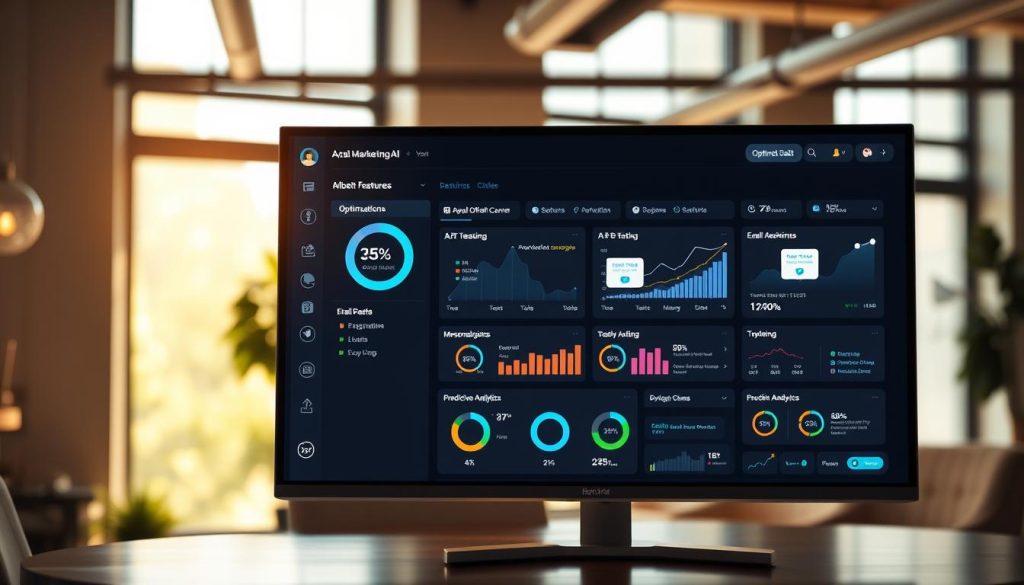
Send-time optimization engines predict the best times to send emails. They stagger delivery based on subscriber behavior. This ensures emails reach subscribers when they’re most likely to engage.
Content personalization systems adjust emails based on recipient profiles and behavior. They change product recommendations and offers in real-time. This makes messages more relevant to each subscriber.
Subject line generators test many variations to find the best ones. Unlike traditional A/B testing, AI systems compare many options at once. They use data from similar campaigns to predict success.
Predictive analytics platforms forecast campaign results before emails are sent. They estimate open rates and conversion probabilities based on content and audience characteristics. This allows marketers to adjust strategies before sending.
| AI Technology | Primary Function | Key Benefit | Implementation Complexity |
|---|---|---|---|
| Send-Time Optimization | Predicts optimal delivery times for individual subscribers | Increases open rates by 20-30% through timing precision | Low – most platforms offer built-in features |
| Dynamic Content Insertion | Customizes email elements based on recipient data | Improves relevance and engagement metrics | Medium – requires data integration and rules setup |
| Predictive Segmentation | Creates behavior-based audience groups automatically | Enables precise targeting without manual analysis | Medium – needs historical data and model training |
| Subject Line Generation | Creates and tests multiple headline variations | Optimizes the critical first impression factor | Low – simple integration with existing workflows |
| Automated A/B Testing | Evaluates multiple variables simultaneously | Accelerates optimization cycles significantly | High – requires statistical expertise and monitoring |
AI-driven segmentation creates audience groups based on behavior. It identifies patterns that show shared interests or purchase intent. These groups update as subscriber behavior changes.
Automated A/B testing compares many variables at once. Traditional testing compares two options one at a time. AI systems evaluate dozens of combinations concurrently, speeding up optimization.
Dynamic content insertion changes offers and recommendations in real-time. If a subscriber viewed a specific product category, the next email will feature relevant items. This happens automatically without manual effort.
These technologies work together to enhance open rates. The send-time optimizer ensures emails are sent when subscribers are most likely to engage. Content personalization makes messages relevant. Subject line generators grab attention. Together, they multiply individual improvements.
Real applications show the impact of AI in marketing. Teams report that AI tools enhance human creativity, not replace it. AI handles data and optimization, while marketers focus on strategy and creative direction. This combination leads to better results than either approach alone.
How AI Analyzes Audience Behavior
AI in email marketing is powerful because it can process millions of data points. It looks at more than just open rates. AI builds detailed profiles of customers to improve campaign results.
AI systems collect and understand data that humans can’t handle. They find patterns in many variables to understand audiences better. This changes how marketers create email campaigns.
Data Collection Methods
AI gathers data from many sources to create detailed profiles. It starts with email interactions like opens and clicks. But it looks at more than just email.
Website browsing shows what subscribers are interested in. AI tracks what pages they visit and how long they stay. It also looks at what they add to carts and their purchase history.
Social media activity adds more to the analysis. AI watches how subscribers interact with branded content. It also looks at customer service chats to understand their needs and preferences.
The best AI uses customer data platforms (CDPs) to combine data from different places. CDPs bring together email, website, purchase, and customer service data. This helps AI see the whole customer journey.
AI notices small details about each subscriber. It knows when they usually open emails and on what device. It even detects when they travel or go on vacation.
AI adjusts when emails are sent to keep subscribers engaged. It knows when to send emails to avoid overwhelming them. This keeps subscribers happy and interested.
AI email marketing tools need lots of good data to work well. The quality of the data affects how accurate the predictions are. Bad data leads to less reliable insights.
Predictive Analytics in Email Marketing
AI uses past data to find the best times to send emails. Predictive analytics for emails focuses on individual subscribers. This approach boosts open rates by sending emails when subscribers are most likely to engage.
AI looks at many campaigns to find patterns. It finds out when and how to send emails for the best results. This often surprises human analysts who rely on old ideas about the best times to send emails.
For example, AI might find that some people buy during lunch but browse at night. Others ignore promotions but open transactional emails quickly. Some like visual emails on weekends and text emails on weekdays.
AI keeps learning and getting better with each interaction. It gets more accurate over time. This means it can give more personalized advice as it gets to know subscribers better.
| Predictive Factor | Data Sources | Impact on Open Rates | Optimization Method |
|---|---|---|---|
| Send Time Optimization | Historical open patterns, timezone data, device usage | 15-25% improvement | Individual-level scheduling based on past behavior |
| Content Preference Prediction | Click patterns, purchase history, browsing behavior | 20-30% improvement | Dynamic content selection matching predicted interests |
| Engagement Likelihood Scoring | Past engagement frequency, recency, message types | 18-28% improvement | Frequency adjustment and re-engagement triggers |
| Subject Line Resonance | Previous subject line interactions, language preferences | 12-22% improvement | Personalized subject line generation and testing |
Advanced predictive analytics for emails look at more than just subscriber behavior. Weather and local events can influence what products people are interested in. This means emails can be more timely and relevant.
AI can spot when subscribers are not engaging and act on it. It can adjust how often emails are sent or start re-engagement campaigns. This keeps the sender reputation good and the list healthy.
Personalization Through AI Insights
AI turns behavioral analysis into strategies that improve results. It adjusts email content, product recommendations, and subject lines for each subscriber. This makes emails more personal and effective.
Personalized emails get 29% higher open rates than generic ones. AI finds out what types of messages and offers work best for different groups. This goes beyond just using first names in subject lines.
AI makes product recommendations based on what subscribers have bought and browsed. It suggests related items when it sees someone is interested in a category. This makes recommendations more relevant and timely.
AI also notices what types of content people prefer. Some like emails with lots of images, while others prefer detailed articles. AI adjusts the layout of emails based on these preferences.
Messaging tone and language style get personalized too. AI knows how to talk to each subscriber based on their past interactions. This makes emails more engaging and relevant.
Email deliverability AI solutions use these insights to keep sender reputation high. By sending emails that are relevant and engaging, these systems reduce spam complaints. This helps emails get delivered to the inbox more often.
Dynamic content blocks change based on real-time data. A subscriber who recently looked at winter coats will see different content than someone browsing summer accessories. Weather-based personalization shows relevant products when it’s cold.
Call-to-action buttons change based on where subscribers are in their journey. New subscribers might see “Learn More” buttons, while repeat customers get “Shop Now” prompts. This makes messages more relevant and increases conversions.
AI also optimizes sending frequency. Some subscribers want daily emails, while others prefer weekly digests. AI adjusts the frequency based on how subscribers engage, keeping them interested without overwhelming them.
AI-Powered Subject Lines
Artificial intelligence changes how we write subject lines by finding patterns humans miss. The subject line is key for 47% of email opens. It’s the first step to getting your message seen.
Traditional methods focus on length, personalization, and urgency. But AI looks at subscriber preferences, timing, and message framing too.
Studies show AI can boost open rates by 5-10%. This means more people see your emails, leading to more sales and stronger customer ties. AI goes beyond just being fast; it finds new ways to engage people.

Crafting Compelling Subject Lines
Traditional subject lines follow well-known rules. These include keeping it short, personal, urgent, and avoiding spam. But these rules can’t capture what each person likes.
AI subject lines are different. They test many ideas at once, finding patterns humans can’t see. AI looks at things like emoji use, word choice, and punctuation to predict what works best.
JP Morgan Chase shows AI’s power with Persado. They saw twice the click-through rates with AI copy. The AI came up with ideas humans didn’t think would work.
The AI came up with ideas humans didn’t think would work, showing AI can find effective ways that surprise us.
AI subject lines offer a big advantage. They test ideas without bias, finding what works for different people. This is different from human marketers, who stick to what they know.
Novo Nordisk used Phrasee’s AI to improve their email subject lines. They saw a 14% increase in click-through rates and a 24% increase in open rates. AI found compliant language that people liked.
AI is great in regulated industries. It finds creative ways to meet strict rules. This is hard for human writers, but AI can do it easily.
| Approach | Testing Method | Variations Tested | Optimization Speed | Personalization Level |
|---|---|---|---|---|
| Traditional A/B Testing | Binary comparison | 2-4 variations | Days to weeks | Segment-based |
| AI-Powered Testing | Multivariate analysis | Dozens simultaneously | Real-time | Individual subscriber |
| Manual Copywriting | Intuition-based | Limited by time | Hours to days | Broad demographic |
| Machine Learning | Predictive algorithms | Unlimited testing | Continuous learning | Behavior-based targeting |
Traditional A/B testing is limited. It tests only a few ideas at a time. AI changes this by testing many ideas at once, based on each person’s past behavior.
Tools for AI-Driven Subject Line Optimization
Now, marketers have tools that use AI for subject lines. These tools are easy to use and offer AI features to everyone. It’s important to know which tool fits your needs best.
ActiveCampaign and Mailchimp use AI to improve subject lines. They can boost open rates by up to 26%. These tools look at your past campaigns and industry trends to suggest better subject lines.
AI subject line tools work by analyzing past campaigns. They consider many factors like word choice and timing. This helps predict how well a subject line will do before it’s sent.
It’s important to choose AI tools that learn from your audience. Some tools rely on general data, while others adapt to your specific audience. This makes the AI more accurate over time.
When picking AI subject line tools, look at several things:
- Training data quality: Tools trained on lots of campaigns usually work better. But, data specific to your industry is also important.
- Audience-specific learning: Tools that learn from your audience do better than those that don’t.
- Platform integration: Tools that work well with your email service provider are easier to use.
- Transparency and explainability: Tools that explain their choices help marketers learn from AI.
- Compliance features: Tools need to understand industry rules while also trying to engage people.
The best approach combines AI with human insight. Marketers check AI suggestions to make sure they fit the brand. This way, AI does the hard work, and humans add a personal touch.
AI subject lines are getting better as AI models improve. They now consider more than just words. This means they can predict what will grab someone’s attention better.
Costs for AI subject line tools vary. Some are free, while others cost a lot. Small businesses might find what they need in tools like Mailchimp. But bigger companies might need more advanced tools like Phrasee or Persado.
The market for AI subject line tools is growing. This means more choices and better prices. But, it also means finding the real AI tools among the fakes is harder. Marketers should ask for case studies and trials to make sure they’re getting the real deal.
Segmentation and Targeting with AI
Machine learning algorithms help marketers find customer patterns that old methods miss. They go beyond basic info like age and location. They create detailed groups that show how people will react to certain content.
AI makes email campaigns more personal, even for small marketers. This used to be only for big companies with data science teams. Now, everyone can make their emails more targeted.
Benefits of AI Segmentation in Email Marketing
AI changes how marketers group their audience. It looks at behaviors that people often don’t notice. For example, it finds people who buy during lunch but browse at night.
AI is fast. It helps marketers build segments 25% faster than old methods. This is because AI can handle complex data quickly, saving a lot of time.
Unlike old methods, AI’s segments change as new data comes in. This means subscribers get emails that match their current interests. It keeps emails relevant and engaging.
Key benefits of AI in email marketing include:
- Real-time adaptation: Segments update instantly as customer behavior changes, eliminating the lag time of manual updates
- Hidden pattern discovery: AI identifies behavioral correlations that human analysts might overlook in massive data sets
- Predictive grouping: Algorithms forecast which subscribers will respond to specific offers based on historical patterns
- Scale without complexity: Manage hundreds of micro-segments without increasing team workload
- Multi-dimensional analysis: Combine purchase history, browsing behavior, email engagement, and external factors simultaneously
Personalizing content is a top use for AI in email marketing. 50% of email marketers use AI for this purpose. This shows AI has become a key tool for success in many industries.
Some people ignore ads but open transactional emails. This shows they’re interested but don’t want too many emails. AI can adjust content to match their preferences.
Implementing AI for Dynamic Content
Dynamic content lets emails change in real-time based on who’s reading them. This means no need for hundreds of different emails. It keeps messages personal and engaging.
AI makes emails more personal by changing content for each person. It looks at data in real-time to make sure emails are relevant. This makes emails feel more personal and engaging.
ON Sportswear shows how AI can work in real life. They use AI to send emails based on what people are interested in. This has led to a huge increase in clicks on non-shoe products.
Endy uses AI to send product recommendations that change in real-time. This means they can offer products that are available and priced right. It makes shopping easier and more enjoyable.
Here are some ways to use AI for dynamic content:
- Behavioral triggers: Set up automated responses to specific subscriber actions like cart abandonment or product browsing
- Contextual variables: Incorporate external factors such as weather, local events, or time of day into content decisions
- Real-time inventory feeds: Connect email systems directly to product databases for accurate availability information
- Progressive profiling: Gather subscriber preferences gradually through interaction tracking, not long forms
- A/B testing automation: Let AI continuously test content variations and optimize based on performance data
Setting up AI for dynamic content needs a good technical setup. But, modern tools make it easier to connect everything. This makes it simpler to start using AI.
AI can make emails more effective by tailoring content to what people like. This saves a lot of time and boosts sales. It makes emails more relevant and engaging.
Marketers who use AI have a big advantage. They can send emails that feel made just for each person. This builds stronger relationships and drives business success.
Case Studies: Success Stories of AI in Email Marketing
Real-world examples show AI’s big impact on email marketing. Companies in retail, finance, hospitality, and food service have seen big improvements. These stories prove AI can really make a difference.
Different companies solved unique problems with AI. They chose how to use AI based on their audience and goals. They all tested and improved their AI use in their marketing.
Industry Leaders Transforming Email Performance
ON Sportswear changed how they suggest products with AI. They use data on what customers like and where they are. This makes their product suggestions more accurate.
ON Sportswear saw a huge jump in non-shoe product clicks. Now, 16% of their online sales come from these smart suggestions.

Hotel Chocolat worked on sending emails at the right time. They use AI to figure out when to send emails to each customer. This approach has cut down on people unsubscribing and boosted sales.
Hotel Chocolat’s unsubscribe rate dropped by 40%, and sales went up by 25%. They learned that sending emails when it matters most is key.
JP Morgan Chase tested AI-written emails against human-written ones. They used AI to find the best words and phrases. The results were surprising.
AI emails got up to twice as many clicks as human-written ones. This shows AI can find the right words that people want to click on.
Novo Nordisk used AI to make email subject lines better. They had to follow strict rules in the pharmaceutical industry. AI helped them find phrases that worked without breaking any rules.
Novo Nordisk saw a 14% increase in clicks and a 24% increase in opens. This shows AI can help even in strict industries.
Groupon and eBay used AI to make their email subject lines better. They deal with millions of emails every day. AI helps them find the best subject lines for different people and products.
Sonos used AI to send emails when products are back in stock. They track many products and send emails when they’re available. This makes customers more likely to buy.
New Look used AI to send birthday discounts. They look at what each customer likes and send a 20% discount on their favorite items. This makes emails more personal and relevant.
Yum Brands used a mix of AI and automation tools. They improved their A/B testing and made upselling and retention campaigns better. This helped all their restaurants.
Quantified Results and Performance Benchmarks
These success stories show what AI can do. The results vary, but some patterns stand out. AI can really help with email marketing.
AI-driven recommendations have boosted revenue by 16% to 25%. Click-through rates have gone up by 14% to 537%. These big jumps show AI’s power.
Open rates have improved by 20% to 30% with AI-optimized subject lines. This shows AI can make emails more engaging. Unsubscribe rates have also dropped, showing AI respects customer preferences.
| Company | AI Application | Primary Metric Improved | Percentage Increase |
|---|---|---|---|
| ON Sportswear | Contextual Product Recommendations | Non-shoe Product Click-Through | 537% |
| Hotel Chocolat | Send Frequency Optimization | Revenue Growth | 25% |
| JP Morgan Chase | AI-Generated Copy | Click-Through Rate | 100% |
| Novo Nordisk | Subject Line Optimization | Open Rate | 24% |
| Hotel Chocolat | Frequency Management | Unsubscribe Rate Reduction | 40% |
These success stories share a common thread. Each company started with clean data and realistic goals. They knew AI would enhance their marketing, not replace it.
They introduced AI gradually, testing each step. This allowed them to learn and improve. It also built confidence in their AI use.
Human judgment was always key. Decisions on brand voice and customer experience were made by people. AI handled the data-heavy tasks that were too hard for humans.
These stories show AI’s wide range of applications. From strict industries to fast-food promotions, AI delivers results. They offer inspiration and practical advice for marketers considering AI.
Challenges of Implementing AI in Email Campaigns
Using AI in email campaigns is more than just excitement. It needs clean data, technical skills, and a clear understanding of challenges. Marketers are drawn to AI’s promise of better open rates and personalization. But, they face complex technical needs and privacy issues.
Many teams are surprised by the gap between AI demos and real results. Success comes from tackling key challenges before AI can make a big difference.
Technical Barriers
Good AI starts with quality data. But, many campaigns fail here. AI tools need lots of clean, relevant data to work well. Bad data means poor insights, wrong messages, and low engagement.
Failure happens when teams lack clean data, realistic goals, or a clear plan. This shows up fast in how well campaigns do.
The biggest challenge using AI in email marketing is data accuracy and integration. Bad data hurts campaign results.
There are many technical hurdles in AI integration:
- Integration complexity when linking AI tools with current email services, CRMs, and analytics.
- Substantial learning curves to set up AI systems right and get the best results.
- Training requirements for brand voice and tone, as AI can’t capture emotional depth without detailed training.
- Data volume thresholds that make AI less useful for small senders with little data.
- Technical expertise gaps that need training or hiring AI experts.
Demos show perfect AI outputs after hours of work and training. AI can’t match a real marketer’s emotional touch or storytelling. This leads to generic content that might miss emotional connections or not fit the brand’s voice.
Most platforms need weeks of data to offer real improvements. This waiting period can be frustrating for marketers. It can also stop AI efforts before they show value.
Data Privacy and Security Concerns
Data privacy, security, and trust are big hurdles for AI in email campaigns. Keeping customer data safe is a must, adding complexity to AI use.
The risks are high, with Gartner data showing 80% of marketers will give up on AI personalization by 2025 due to poor ROI or privacy issues. This high failure rate means careful planning and risk assessment are essential.
Privacy is key because most emails aren’t useful, and many have too many unread emails. Privacy mistakes can harm relationships.
Email AI must consider several privacy issues:
- Consent management for data use across different touchpoints and channels.
- Transparency requirements about AI’s use of customer data for targeting.
- Compliance with GDPR and CCPA rules on automated decision-making.
- Reputational risk management when AI suggests inappropriate or untimely messages.
Email AI must balance optimization with privacy. Using data to improve relevance is good, but crossing ethical lines can harm trust and campaign success. Consumers are more aware of and concerned about how brands use their data.
As privacy laws change, marketers must keep up. This means ongoing legal checks and technical updates. These steps add cost and complexity to AI projects.
Future Trends: AI and Email Marketing
Artificial intelligence is changing email marketing in big ways. Predictive analytics and automation are coming together. This means brands can build better relationships with their audience.
Marketing pros who use these new tools will get a big edge. They’ll be able to do things that others can’t.
This change is not just about new tech. It’s about how we think about creating and connecting with customers. AI is getting smarter, helping marketers be more creative, not less.
Emerging Technologies to Watch
Generative AI can now make true 1:1 personalization for every email. This is more than just customizing for groups. It’s making content that’s unique to each person, based on their history and what they might need next.
This tech looks at lots of data at once. It uses past purchases, browsing, and email history to make messages that really speak to people. This level of personalization was hard to do before.

First-party data is key now. Marketers are moving away from old data exchanges. Getting data directly from customers gives better insights and builds trust.
AI is great at using this data to connect with people. It helps create messages that really resonate.
Real-time sentiment analysis is another big leap. It can tell how someone feels from their interactions. If someone seems upset, AI can change the email to address their concerns.
Voice and video content generation are growing fast. Marketers can now send emails with personalized video or audio. This makes messages more engaging and personal.
AI can also predict how valuable a customer will be. This helps marketers plan better and build stronger relationships. The models get better over time as they learn from new data.
Creating content will get a lot faster. AI will handle routine checks, making the process much quicker. Quality will stay high, but the process will be faster.
| Capability | Current AI Technology | Emerging AI Technology | Expected Timeline |
|---|---|---|---|
| Personalization | Segment-based customization | True 1:1 individualized content for each recipient | 2024-2026 |
| Content Creation | Template modification with AI assistance | Fully generated multimedia content (text, voice, video) | 2025-2027 |
| Predictive Analytics | Send time and subject line optimization | Real-time sentiment analysis and emotional state detection | 2024-2025 |
| Data Strategy | Mixed first and third-party data sources | AI-powered first-party data acquisition and integration | 2024-2026 |
Predictions for Email Open Rates and AI Integration
The market for AI in email marketing is growing fast. It’s expected to grow at a compound annual growth rate of 26.3%, reaching $2.7 billion by 2025. This growth is due to more people using AI and new tech.
In the next two to five years, email marketing will change a lot. Marketers who know AI will lead these changes. Knowing how to use AI will be as important as being creative.
AI will help marketers make more empathetic content. It will help them understand how people feel and make messages that connect. The focus will shift from just selling to building relationships.
Trust is key in email marketing. As AI and data get more connected, being open and ethical is essential. Customers want to know how their data is used, and brands that are transparent will win.
Open rates will likely go up as AI gets better. Emails will be sent at the best time and with content that really interests people. AI will make guessing work a thing of the past.
Companies that use AI and human creativity well will do better. AI helps, but it doesn’t replace human skills. Combining strategy and analysis will lead to better results.
Marketers who don’t use AI will fall behind. The gap between those who use AI and those who don’t will grow. Companies need to invest in tech and training to stay ahead.
Predictive analytics will do more than just optimize emails. They will help make bigger business decisions, like product development and customer service. Email marketing will become a key place for customer insights.
The role of marketing pros will change with these new tools. They need to understand both creative ideas and how to use tech. Teams need people who can connect human insight with machine power for the best results.
Best Practices for Using AI in Email Marketing
Starting an AI email marketing program needs ethics, strategy, and technology. Marketers who rush in without groundwork often fail. Successful companies first focus on data ethics, privacy, and AI culture before using AI tools.
Setting clear goals and plans for AI is key before starting. Many companies use AI without clear business goals. This wastes resources and doesn’t improve campaign results.
Starting with Strategic Integration
Effective AI use blends AI with proven email marketing strategies. This mix of new and old is the best way to succeed. Research shows 65% of marketers use AI as a tool, not a replacement.
Start with simple AI features in email marketing tools. These include send-time optimization and content selection. They offer quick benefits without needing tech skills.
Implement AI in a step-by-step way to build trust and skills. Begin with basic features for quick wins. Then, move to more complex emails for different customer groups.
Start with your current email data. Grow customer profiles by adding data from other channels. This helps AI make better predictions and personalization.
While 47% of email marketers use AI, it’s not for everything at once. Start with a few AI features and add more as they prove useful. This approach avoids overwhelm and helps teams master each feature.
Use AI to personalize your audience better. Learn to guide AI to create content that fits your brand. The AI will get better with your feedback.
Maintaining Performance Through Continuous Optimization
AI is an ongoing process, not a one-time task. Organizations that ignore this risk losing performance. Regular checks ensure AI tools keep delivering.
Set baseline metrics before using AI. Track key indicators before and after adding AI features. This shows what works and what needs tweaking.
Good testing is key for reliable results. Test one thing at a time with a control group. Leading platforms automate this for continuous testing.
| Testing Approach | Implementation Method | Success Indicator |
|---|---|---|
| Single-variable testing | Test one element at a time with control group | Clear attribution of performance changes |
| 30-day baseline periods | Measure metrics before AI implementation | Accurate improvement calculations |
| Continuous automation | Use platform tools for ongoing tests | Consistent optimization without manual effort |
| Multi-channel analytics | Connect email to web, app, and sales data | Business impact beyond email metrics |
Use a system for analytics, iteration, and retargeting. Connect email to web and app conversions. This ensures AI optimization meets revenue goals.
AI models get better over time with more data. Be patient and keep feeding the AI. Organizations that stick with it see big returns.
Regularly check AI suggestions to match brand values and goals. This is critical during market changes or company shifts. AI might keep optimizing for old patterns without human review.
Combining strategic integration with continuous improvement gives a competitive edge. AI email marketing gets better with each campaign. This is what sets leaders apart from followers.
Conclusion: Is AI the Key to Better Open Rates?
Can AI improve email open rates? The answer is yes. AI-driven email campaigns see a 50% boost in open rates. Businesses using AI see a 41% jump in click-through rates and a 20% increase in conversions.
The financial benefits are clear. Marketers using AI see an average order value of $145.08. This is $7.08 more than those not using AI. This difference adds up quickly with thousands of customers.
What the Numbers Tell Us
AI’s impact on email campaigns is undeniable. 92% of marketers say AI boosts email campaign ROI. An impressive 99% of marketers using AI for email report positive results.
AI is best as a tool to support big goals. It helps with content creation and testing, finding ways to improve campaigns on a large scale.
Many talk about AI’s capabilities, but few show its real-world impact. Start small, focusing on one problem where manual effort is inconsistent.
Your Next Steps
Begin by cleaning your data. Remove hard bounces, suppress unengaged subscribers, and check tracking pixels.
Choose one AI feature to test. Measure baseline performance for 30 days, then track changes for another 30 days. Note what improves.
Keep human oversight on strategic decisions. Use AI for data-intensive tasks while humans handle messaging strategy and sensitive communications. The edge goes to those who mix human creativity with AI capabilities now.